
Home
Rip Cards Online 2026: Compare the Best Card Rips Sites & Apps
Best Trading Cards to Collect 2026
Best Baseball Trading Cards to Buy and Invest in for 2026
Contains commercial content
Best Baseball Trading Cards to Buy and Invest in for 2026: Top Choices and Buying Guide
Last Updated on 19.10.2026
Baseball is one of the leading sports, so it’s not surprising that there’s a lot of hype around its trading cards. However, to find the best baseball trading cards, you must ignore the hype and actually focus on value.
We created this page to cut through the noise and give you the top five options that truly stand out in today’s market. Of course, as more cards are released, the value and demand of existing ones are bound to change. Likewise, we update our list to reflect the necessary changes. Keep reading to learn more about these trading cards.
Table of Contents
What are the best baseball trading cards to collect?
If you’re a baseball fan, you most likely have favorite teams and players. In that case, you prioritize certain baseball card sets or individual cards when building your collection. However, if you’re looking for the trading cards with the strongest value currently, these five stand out from the rest:
Mickey Mantle #311 (1952 Topps)
| Year/set | 1952 Topps |
| Card Number | #311 |
| Significance | Holy grail of baseball trading cards |
| Highest sale | $12.6 million |
Mickey Mantle #311 is one of the most famous baseball cards ever made. It is often called Mantle’s rookie card, though his true rookie is the 1951 Bowman card. Plus, it comes from the famous high-number series that Topps struggled to sell in 1952, and its rich history is one reason why surviving high-grade copies are so scarce.
For example, in 2022, an SGC 9.5 graded as the finest known example sold for $12.6 million, the highest price ever paid for a sports card. Even lower grades often trade for six figures.
Jackie Robinson #30 (1956 Topps)
| Year/set | 1956 Topps |
| Card Number | #30 |
| Significance | Robinson’s final Topps Card |
| Highest sale | $170,800 |
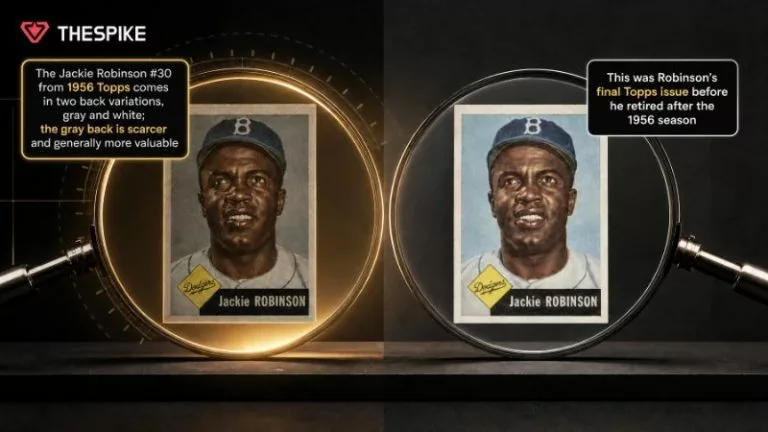
The Jackie Robinson #30 from 1956 Topps comes in two back variations, gray and white; the gray back is scarcer and generally more valuable. This card represents one of the most significant figures in American sports history. That’s Robinson, someone who broke baseball’s color barrier and changed the game forever. It was also Robinson’s final Topps issue before he retired after the 1956 season, another factor that makes it one of the most valuable baseball cards.
Hank Aaron #128 Rookie (1954 Topps)
| Year/set | 1954 Topps |
| Card Number | #30 |
| Significance | Robinson’s final Topps Card |
| Highest sale | $170,800 |
Hank Aaron #128 from the 1954 Topps set is widely recognized as Aaron’s rookie card. The card, with its bright orange background, shows “Hammerin’ Hank” early in his career, before he became one of the greatest hitters in baseball history. The Professional Sports Authenticator (PSA) has graded thousands of copies, yet only around 25 have reached a 9 and just two have hit a perfect 10. This shows how difficult it is to find this card in top condition. A PSA 9 copy sold for $720,000, and even well-worn options still hold solid value thanks to consistent demand.
Ken Griffey Jr #1 Rookie (1989 Upper Deck)
| Year/set | 1989 Upper Deck |
| Card Number | #1 |
| Significance | Defining modern-era rookie card |
| Highest sale | $5,999 |
Ken Griffey Jr. #1 from the 1989 Upper Deck is one of the most iconic modern baseball rookie cards. Although it launched in the “junk wax era,” a period when overproduction affected most card values, it remained a top trading card. As the number 1 issue in Upper Deck’s debut set, it was the first to use premium stock and higher-quality photography.
Mike Trout US175 Rookie (2011 Topps Update)
| Year/set | 2011 Topps |
| Card Number | US1 |
| Significance | Rookie card of Mike Trout |
| Highest sale | $9,000 |
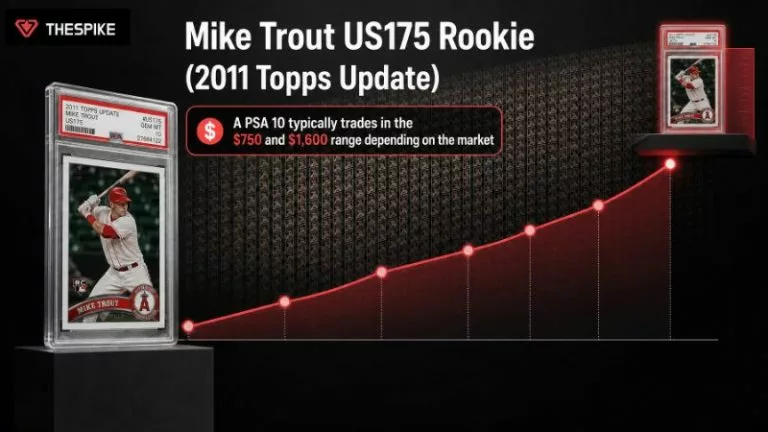
This is Trout’s rookie card. It was printed in massive quantities but remains valuable because the player behind it is considered the best of his generation. Issued after his mid-season debut, the card features the clean flagship Topps design.
There are currently tens of thousands of graded copies, so this isn’t a scarcity pick like the vintage cards above. A PSA 10 typically trades in the $750 and $1,600 range depending on the market at the time. This makes it a good entry point for newer collectors who want a star’s rookie card without the pricing that comes with more vintage options.
How we judge the best baseball trading cards
Below is a breakdown of the factors we consider when putting together our list:
Verified auction sales
Auction results give a true picture of what collectors are actually willing to pay. That’s why we look at real, completed sales from major platforms and auction houses instead of focusing on a single price entry.
Current estimated market value
We know that card values shift based on players’ performances, trends, and collector demand. As such, a card that was priced high two years ago might not have the same value today. So, beyond individual auction records, we look at ongoing market value based on recent sales data, tracking how a card has performed over the last several months.
Historical significance
Some cards matter because of the moment they capture. Take rookie cards of Hall of Fame players, for instance. Since they debuted before the player actually made it big, the card holds more weight for collectors. When ranking baseball cards, we always factor in that historical significance alongside financial value.
Player’s legacy
The value and demand of a player’s trading cards also depend on the player’s career. Cards of players who make it to the Hall of Fame, set milestones, or are remembered because of their talents are usually more valuable than those of short-term stars. As a result, we always weigh in the player’s legacy when ranking cards.
Fanbase and unique cards
Some baseball players have a large fan base that pushes their card values higher than what their career numbers would. We pay attention to cards that become more popular simply because they capture a player in a specific iconic pose or they have unique design elements.
Scarcity and graded population
Scarcity is one of the biggest factors that affects the value and demand of baseball trading cards. While we consider the number of copies originally printed, we also look at how many survived in good condition and how many are in top grading tiers.
Sets they come from
The set a card comes from is as important as the player on it. Cards in flagship releases like 1952 Topps or 1989 Upper Deck usually hold their weight compared to cards in other sets. That said, we consider a set’s overall reputation, print run, and popularity among collectors.
Which cards should you add to your baseball trading card collection?
Our rankings are a great starting point, but your personal collection should reflect your own taste and interests. If this is your first time collecting baseball cards, you’ll want to know the type of collector you are. That way, you can know the
best sports trading cards
to go after. On that note, here are the most common types of baseball card collectors and the best approach to use, depending on where you fall.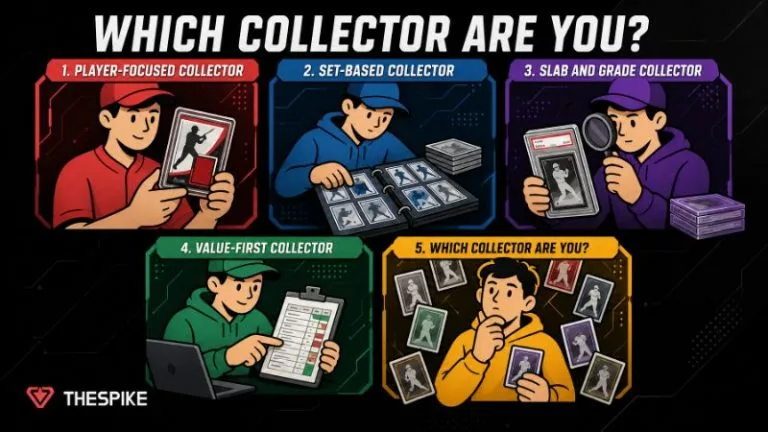
🎮 Player-focused collector
Most collectors in this category are driven by loyalty and do not necessarily focus on overall value. Such collectors might be interested in a player they watched growing up or a specific team.
For instance, if someone is a fan of Mickey Mantle, Hank Aaron, Jackie Robinson, Ken Griffey Jr., or Mike Trout, they will often prioritize the most recognizable rookie or flagship card for that player. If this is you, always focus on the card conditions for long-term sustainability.
📚 Set-based collector
Collectors in this category focus on complete runs from a specific year or product. Good instances are 1952 Topps, 1954 Topps, 1956 Topps, 1989 Upper Deck, or 2011 Topps Update. Such collectors often enjoy the challenge of filling the gaps and tracking card designs across a full release.
If you fall into this category, opt for card sets instead of just individual cards. Of course, these sets would not always be complete, so you can also participate in baseball card rips to open packs and try pulling missing pieces.
🔍 The Slab and Grade Collector
For some collectors, card grade is one of the most important factors because it affects condition, authenticity, and resale value. They often target copies graded by well-known companies like the Professional Sports Authenticator (PSA), Sportscard Guaranty Corporation (SGC), and Beckett Grading Services (BGS).
If this is your style, always check population reports when looking for the best baseball trading cards to buy. That’s because low population counts can make a card scarcer. For example, a PSA 10 with 15,000 graded copies is not so rare compared to a PSA 9 with only 10 graded copies.
💰 The Value-First Collector
If long-term value is your priority, then there are a few things to keep in mind when selecting baseball trading cards. First is the scarcity at the top grades, not just a low print run overall. You should also look for players with an established legacy rather than short-term hype, as their card value is more likely to appreciate over time.
Get vintage cards when possible. Such cards are sometimes more appealing than newer versions because of their historical significance. Before buying, check the track record of real, documented sales instead of just focusing on the asking prices.
❓ Which collector are you?
In our opinion, there is no fixed way to go about collecting baseball cards. You don’t have to fit or limit yourself to one category. Instead, find what makes you happy. If you just prefer collecting random cards and sorting them based on teams, do that instead. Over time, you might find a collection approach that works best for you.
Final thoughts on the best baseball trading cards
Whether you’re after baseball cards that have historical significance or long-term value, you need to research to find the best ones. We’ve helped with that by providing you with the five best baseball trading cards. To recap, we have the 1952 Topps Mickey Mantle #311 at the top of the list, followed by the 1956 Topps Jackie Robinson #30, and the 1954 Topps Hank Aaron #128, Aaron’s rookie card. The last two on our list are the 1989 Upper Deck Ken Griffey Jr #1 and the 2011 Topps Update Mike Trout US175.
Again, our ranking is based on several factors, including market value and the player’s legacy. However, your own collection can be different based on your baseball interests. The goal is to enjoy the building process as much as your full collection, so feel free to explore. If you do want to add any of our recommendations to your list or simply participate in card rips, check out our banners for the card rip sites around.
Best baseball trading cards FAQs
🛒 Where is the best place to buy baseball trading cards?
The best place to buy baseball trading cards depends on what you’re after. You can opt for established auction houses when looking for extremely high-value vintage cards. Meanwhile, online marketplaces work well for everyday buying and selling. Consider local card shops if you want to inspect cards in person and build relationships with sellers before buying. You can also participate in live card rips.
🫰🏻 How can I tell if my baseball card is valuable?
The value of your card depends on a few key factors, including the player, the year and set, the card’s condition, and how many copies exist in that condition. Most of the time, rookie cards of Hall of Famers hold the most value, especially from vintage sets with lower populations.
⚾ What’s the difference between a rookie card and a base card?
A rookie card is a player’s first officially licensed card. It is usually issued during or after their debut season, and it’s almost always the most sought-after card of that player’s career. A base card is simply the standard card in a given set, which could feature a player at any point in their career. Rookie cards are usually more valuable, especially if they’re of players who enter the Hall of Fame.
🔢 What do PSA, BGS, and SGC mean on a graded baseball card?
They mean Professional Sports Authenticator, Beckett Grading Services, and Sports Card Guaranty. These are the three major grading companies. Each one evaluates a card’s centering, corners, edges, and surface. They then assign a number grade, usually on a scale of 1–10, before sealing it in a slab.



Play Packed
4.6/5


Play Packed Promo
100% Buyback
T&Cs apply
4.6/5
More Card Rips Articles
Our Team
Editor
Close

T&Cs and 18+ apply

T&Cs and 18+ apply

T&Cs and 18+ apply