
Home
Rip Cards Online 2026: Compare the Best Card Rips Sites & Apps
Best Trading Card Sets 2026
Best Baseball Card Sets for Collectors & Investors
Contains commercial content
Best Baseball Card Sets for Collectors & Investors: Top Baseball Card Collections to Consider in 2026
Last Updated on 19.10.2026
Baseball is THE American sport. It’s been around for decades, with the MLB being the most popular professional baseball league in the world. As an offshoot from this, we also have some epic baseball trading cards.
But, which are considered the best baseball card sets? Which collections are revered for their value, content, and contents? This is what we are looking at below and if you read on, we’ll go through what we consider to be the current top 5 baseball trading card sets that you can buy.
Table of Contents
The Best Baseball Sets To Check Out This Month
Baseball cards are some of the oldest trading card sets you can get – in fact, baseball was the first sport to reportedly ever have trading cards, with records showing that they have been around in some form since 1860! Because of that, a lot of the top baseball card sets are OLDER – we’re talking 40+ years old, which is a stark contrast to other series like Pokemon, Yugioh, and One Piece.
On top of that, everyone has their own tastes, interests, and reasons for collecting, and with that in mind, we’ve tried to give a balanced and realistic list of the top baseball card sets below. We’ve used metrics like highest sales, individual valuable player cards, historical significance, and scarcity, PLUS, the general feel and trends of current baseball card collectors.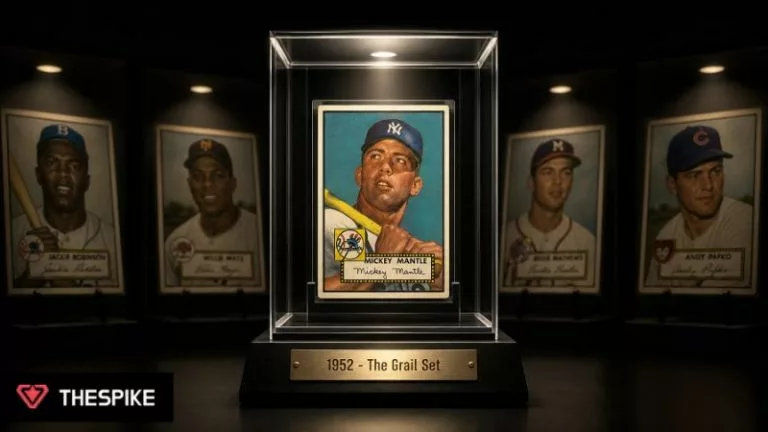
Topps 1952
| Card/Player | Team | Series Number | Why Is It Hot? |
|---|---|---|---|
| Mickey Mantle | New York Yankees | #311 | Baseball fans know why — he is one of the greatest legends in the sport. |
| Jackie Robinson | Brooklyn Dodgers | #312 | The first African American player in MLB history and an iconic figure in baseball. |
| Willie Mays | New York Giants | #261 | A 24-time All-Star, World Series champion, and one of baseball’s most historically significant players. |
For many, when it comes to expensive baseball cards, the Topps 1952 set is often considered THE grail. It’s widely recognized as the best post-WW2 set which contains a heap of legendary baseball stars. Compared to the design and style of modern baseball cards, this set looks incredibly basic, with each item essentially containing a photo of the player, their name, and team badge.
BUT, it’s not about the design – it’s the history, the age, the scarcity, and the players that make it so iconic, with many of the legends contained in the set going on to shape modern baseball in the US. The ultimate card from this set is Mickey Mantle – the Commerce Comet himself, who is widely seen as one of the greatest sluggers of all time. However, there’s almost an endless list of other top players including Jackie Robinson, Willie Mays, Eddie Mathews, and Andy Pafko.
Topps 1956
| Card/Player | Team | Series Number | Why is it hot? |
|---|---|---|---|
| Mickie Mantle | New York Yankees | #135 | This was his legendary Triple Crown year. |
| Yankees Team Card | New York Yankees | #251 | One of the earliest forms of an MLB team card. |
| Ted Williams | Boston Red Sox | #5 | Iconic player, the last to hit over .400 in a season. |
The next evolution of baseball card sets came only a few years later with the Topps 1952 set which was only the second series that they chose to create horizontally aligned cards instead of vertical. In addition to that, the general design of the cards was improved and each player card typically featured a portrait shot of the player, plus a still in-game photo.
In terms of value and collectability, this is another all-time great set as it features the Luis Aparicio rookie card together with a host of other baseball legends like Ernie Banks, Ted Williams, Yogi Berra, Willie Mays, and of course, Mickie Mantle. Now, the Mantle card is especially valuable in this set because 1956 was the year that he won the League Triple Crown, leading all players in batting average, home runs, and runs.
Topps 1975
| Card/Player | Team | Series Number | Why is it hot? |
|---|---|---|---|
| Robin Yount | Milwaukee Brewers | #223 | A PSA 10 of this rookie card has sold for $83k! |
| 1975 Rookie Outfielders | N/A | #616 | A unique rookie card with four would-be stars. |
| George Brett | Kansas City Royals | #228 | Another highly south after rookie card. |
Topps went absolutely wild with this set, especially with the frame designs – in true 1970s hippie fashion, each of the cards featured a vibrant multi-colored frame which was a stark contrast to many of their more reserved and subdued frames of past sets. From a design standpoint alone, it’s one of the most unique baseball card sets which only adds to its collectability and value.
There were also some cool subsets within this classic set such as Highlights Record Breakers, MVPs through the years, and League Leaders. If you’re a rookie card chaser, there’s star players like George Brett, Robin Yount, Jim Rice, and Gary Carter, plus some cards of legends who would go on to retire from the sport at the end of the season including Bob Gibson, Harmon Killebrew, and Al Kaline.
Topps 1989
| Card/Player | Team | Series Number | Why is it hot? |
|---|---|---|---|
| Pirates Leaders | Pittsburgh Pirates | #699 | A unique team leaders card |
| Terry Steinbach | Oakland Athletics | #725 | Typically one of the more scarce cards in the set |
| Randy Johnson | Montreal Expos | #647 | One of the better rookie cards from the set |
Now we are getting into a slightly more modern era, although the Topps 1989 set is still a far cry from the style and design of baseball and football card sets we know today. Although this set was produced during the “Junk Wax Era” (where baseball cards were generally seen to be overproduced and thus their value dropped), it does contain some brilliant cards and is still revered as a pretty damn good pick up – especially for new baseball card collectors due to the relatively lower price compared to the older sets.
The top card within this set is easily Ken Griffey Jr., but it’s got plenty of other top pulls such as star players like Nolan Ryan, Ryne Sandberg, Mark McGwire, and Roger Clemens. In addition, there are some decent rookied cards from players who would go on to make a name for themselves like John Smoltz, Gary Sheffield, and Randy Johnson.
Topps 1993
| Card/Player | Team | Series Number | Why is it hot? |
|---|---|---|---|
| Derek Jeter | New York Yankees | #98 | MLB Hall of Fame legend! |
| Phil Stephenson | San Diego Padres | #357 | Scarce card not readily available on the market |
| Jim Edmonds | California Angels | #799 | Another highly sought after rookie card |
An absolute behemoth of a set – the Topps 1993 collection could be another top pick for new collectors, as it features over 800 cards, so there is plenty to get stuck into and potentially get from baseball card rips or other sources. We like the addition of All-Star cards in this set, and the Veteran and Rookie cards which always hold their value nicely.
In terms of design, things are kept pretty simple, although here we see a greater range of parallels and inserts including Topps Gold and Black Gold which were much more scarce than the standard base card types. Easily the most valuable and iconic card within this set is the rookie Derek Jeter card, and other notable names include Jim Edmonds, and veterans like Barry Bonds, Cal Ripken Jr, and Roger Clemens.
How We Judge The Best Baseball Sets
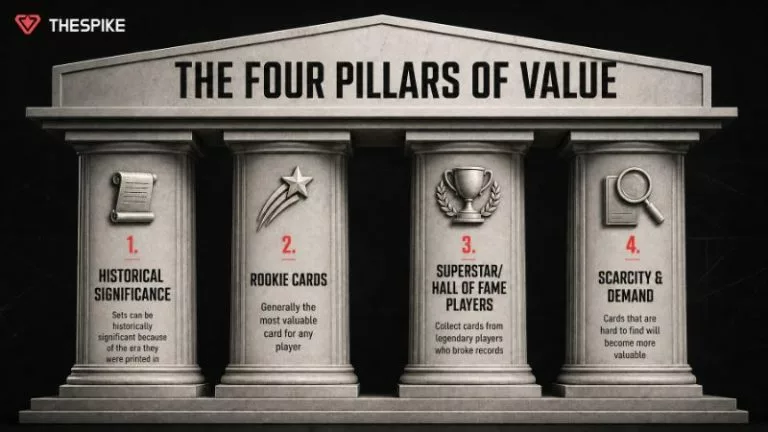
There is A LOT that goes into making baseball cards complete sets valuable and there’s not just one factor. Instead, you’ve got things like the players themselves, the design and quality of the cards, the age of the set, and the general supply and demand. Below, we’ve listed the four key metrics we look at when judging the best baseball card sets:
📜 Historical Significance
Oftentimes sets are historically significant. Perhaps because of the era they were printed in such as the 1952 post-WW2 Topps set. They can be significant because they introduced new features, different card designs, or a groundbreaking new type of card. There’s also historical significance in terms of what happened in that year for World Series champions, MVPs, and other major awards and statistics categories.
🌟 Rookie Cards
Generally, rookie cards are THE most valuable for any player, unless they have a card from a historically significant statistical year.
🏆 Superstar/HoF Players
People want to collect cards from legendary baseball players who broke records, were multiple All-Stars, and who changed the game during their careers. This is why we look at the superstar value, and see if a set contains any Hall of Famers, or truly significant baseball studs.
📈 Scarcity and Demand
Ultimately, if cards from a particular set are hard to find with few sellers, their value will only increase. This is why we look at the basic mechanics of supply and demand, just like in any other business.
Which Baseball Set is The Right Option For You?
Every collector has a different goal. Some people want the grail cards, others love the history of the sport and want cards that are significant, and of course, there are those of us who are just starting out in the world of baseball trading cards. With that in mind, we’ve listed three common types of collectors below, and given you our thoughts on which of these baseball card sets we think could be a great place to start:
- For beginners: We think the 1993 Topps set from our list could be a good starting point if you want to make a gentle splash into the pool of baseball card sets. There’s 800+ cards you can collect, many of them you can get for bargain prices, and we think this set introduces you to some core features such as insert cards.
- For grail chasers: If you’ve got a lot of cash to splash, and you want to go for the immense PSA 10 cards from baseball legends, a great starting point is the Topps 1952 set – it’s got Mickey Mantle in, and you can’t get much more epic than that.
- For historians: if you’re a historian of the game and you purely want iconic cards that have historical significance then once again, it has to be the 1952 and 1956 sets due to their age, their post-war significance, and the number of legendary baseball players who shaped the game that they contain.
Conclusion: Are Baseball Card Sets Worth It?
Baseball card sets remain some of the most prized in the sports trading card world – they have a ton of history, are some of the oldest cards you can find, and this was the first sport that really started off the whole trading card craze. We believe that the 1952 Topps set is THE pinnacle at the moment due to the stacked legends cards inside and the age, but sets from other years like 1956, 1975, 1989, and 1993 all have their unique draws and collector potential.
If you want to get involved and either start or grow your baseball card collection with pulls from these all-time great sets, you can look at and click on any of the banners we have on this page which feature a range of recommended sites that you can sign up at today.
FAQs About Baseball Card Sets
💰 Why are baseball card sets valuable?
Baseball sets can be valuable because they often include rookie cards of future Hall of Famers, limited-print or short-print cards, autographs, memorabilia cards, and historically significant releases. Complete sets in excellent condition, especially vintage ones, are also sought after by collectors, increasing their rarity and market value.
🏆 Which is THE best baseball card set?
The Topps 1952 is often considered the grail set, but it really comes down to what you want from your collection – maybe you support a particular team, want to collect rookie cards, or are looking for those prized parallels and inserts from more modern sets.
🛡️ How do you look after your baseball card sets?
If you are ripping physical packs, you need to take extreme care when doing so and have sleeves ready to put the cards inside. To get the best resale value, you also need to have the cards graded by the proper organizations such as PSA or BGS.



Play Packed
4.6/5


Play Packed Promo
100% Buyback
T&Cs apply
4.6/5
More Card Rips Articles
Our Team
Editor
Close

T&Cs and 18+ apply

T&Cs and 18+ apply

T&Cs and 18+ apply