
Home
Rip Cards Online 2026: Compare the Best Card Rips Sites & Apps
How to Grade Trading Cards 2026
How to Grade Pokémon Cards 2026
Contains commercial content
How to Grade Pokémon Cards 2026: A Step-by-Step Guide for Beginners
Last Updated on 19.10.2026
You know where to find Pokémon cards and what to expect from your packs, but do you know how to grade your Pokémon cards? Well, by the end of this guide, we should have covered just about everything.
We begin with a closer look at the types of Pokémon cards that you should consider grading, focusing on centering, edges, corners, and surface scratches. From here, we guide you through the grading process and even share some of the biggest (and most expensive) graded slabs from within the hobby. Shall we get into it?
Table of Contents
- What does it mean to grade Pokémon cards?
- Why would you wish to grade your Pokémon cards?
- Key considerations that often get overlooked: Card grading companies, postage, and packaging
- Steps to help choose gradable Pokémon cards
- Some of the most valuable graded Pokémon cards available today
- Optional ways to add graded cards to your Pokémon collection
- Final comments: Could your collection be home to a PSA or BGS 10?
- How to grade Pokémon cards FAQ
What does it mean to grade Pokémon cards?
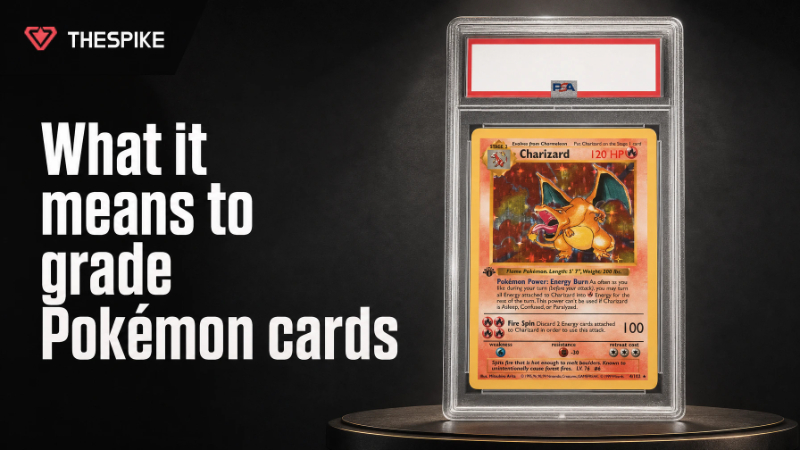
Before we focus on how to grade cards, it is worth explaining what a graded Pokémon card is. In its simplest form, a graded card refers to any card that has been judged by a company and placed in its own slab. Pokémon cards will be critiqued across various categories, and this will help towards your final grade. The hope is that you will end up with a 10 – the highest grade of them all. However, you can end up with anything from 1-10 based on its overall condition.
Why would you wish to grade your Pokémon cards?
There are a number of reasons why you may wish to grade your Pokémon cards. However, the most common reason will revolve around the value of your cards. Should you end up with an 8, 9, or 10 grade, you’ll often find that the price goes up.
That said, the recent boom in popularity means that you may not find an increase in value unless you receive a 9. This makes it even more important to understand what cards are worth grading from your Pokémon collection.
Alongside a potential price increase, you may find that some collectors wish to grade Pokémon cards to keep them uniform or to preserve them. A collection of PSAs and BGS is incredibly sought-after, but you’ll also find that the unique graphic labels from ACE are proving increasingly popular.
Key considerations that often get overlooked: Card grading companies, postage, and packaging
 We have touched on card grading companies briefly, but they really can affect the overall price. PSA and Beckett will be the most expensive options, but often hold the most credibility when it comes to resale value. As mentioned, ACE has fun graphic labels that are helping them to grow in popularity, and lower-end grading companies are an option for those who are focused on preserving cards within a stricter budget.
Beyond the grading company you select, you also need to focus on tiers. Most grading companies will split submission costs based on the value of your collection. In essence, those of you with higher-end cards will be expected to pay more, with a premium added for those who are looking for swifter turnaround times. Naturally, the reverse is true of lower-value cards with a longer waiting time.
With all of this sorted, you then need to consider packaging and sending things off. We recommend you stock up on the following:
- Sleeves
- Top loaders
- Bubble wrap
- Boxes
Top tip: The best option is to wait until you have a number of Pokémon cards to grade before sending things off, as this cuts the overall cost of packaging down. Not to mention that cards placed back to back will add another layer of security, and help to keep them flat during transit.
Steps to help choose gradable Pokémon cards
Of course, before you start to package things up and send your collection off, you’ll need to judge which cards are gradeworthy. We find that you can split this into a few easy-to-follow steps.
-
Purchase and open your packs. To begin, you’ll have to grab some packs. This is a little harder at the moment for Pokémon fans, but you will find them out there. You can open packs on a Pokémon rip site, visit a store in person or online, or buy packs from vendors at a card show.
-
Get sleeves and top loaders at the ready. Once you’ve found your packs and opened them, you’ll then want to get your sleeves and top loaders ready. We find that this is a good idea, as any top finds can be quickly protected.
-
Check for centering, scuffs, and damage. When you have filtered out higher value cards or those you plan to add to your collection, you can start the process of reviewing your cards. Pokémon cards are primarily judged in four separate areas, and this table covers all you need to know.
Centering This refers to how central or even your Pokémon cards look. An off-center card will dent your overall grade, as you need things to be perfect for a score of 10. Centering tools offer a useful way for you to confirm your suspicions Corners Corners are often the first thing to be damaged during pack openings, general handling, or during transit. So, we always suggest paying attention to any whitening or damage before sending off Sides The sides are another area that is heavily scrutinized by card grading companies, and you will need to ensure that there is no whitening, damage, bends, or tears before sending your cards off for official grading Surface The surface is crucial with Pokémon card grading. Grading companies won’t want to have scratches on vintage holos or swirls, and you want to check that there are no clear marks on modern full arts, SIRs, and IRs. The back of the cards is just as important, and you’ll need to look out for smearing, blotches, and any clear scratches there, too -
Protect your cards with sleeves and top loaders. When you have checked your cards and are happy with your decisions, the trick is to keep them protected and avoid taking them in and out of sleeves or toploaders as much as possible. In fact, we suggest sleeving them, putting them in a toploader, and keeping them separate from your other cards.
-
Get a second opinion on your cards. If you have a card grading tool or can get yourself down to a card show for a second opinion, then that is the next obvious move. Let us just remind you that a second opinion doesn’t guarantee a grade, but it does take any personal bias out of the equation.
-
Choose a grading company. All done? Then it must be time to choose your grading company. As we have mentioned, you’ll get different perks from different grading companies, such as unique graphic labels or a higher chance of a better resale value.
-
Package and send things off. With your company chosen, you then need to focus on packaging and sending things off. You can choose a tier that suits your budget, and this usually involves a surcharge for those looking at same-day turnarounds. Packaging is equally as important, as any damage in transit will significantly affect your final grade. Get the bubble wrap and a sturdy box at the ready.
-
Wait for your cards to be returned. You can often follow the current status of your Pokémon cards through your card grading company, but we would also suggest tracking your cards via the postal service you select. Then, it is a case of waiting until they are returned to find out the results – we will keep our fingers crossed.
Some of the most valuable graded Pokémon cards available today
That should have covered the full process. Now, let us share some of the most valuable graded cards within the Pokémon community.
| Pokemon Card | Set | Company | Grade | Est. Value |
|---|---|---|---|---|
| Pikachu Illustrator | Promo card | PSA | 10 | $16,492,000 |
| Charizard (No rarity) | Japanese Base Set | PSA | 10 | $1,700,000 |
| No.1 Trophy Pikachu | First Tournament Gold | PSA | 8 | $982,100 |
Optional ways to add graded cards to your Pokémon collection
You can soon send off your Pokémon cards to be graded, but you will also find alternative ways to add graded slabs to your collection. We cover three key ways here.
🛒 In-store or online purchase
You will find Pokémon stores and online sites that allow you to purchase graded cards directly. This is one guaranteed way to end up with the card and grade that you want, but it will come at a cost.
🏪 Card shows
Alternatively, you could look to make a purchase at a card show. The only difference here is that you are keeping things within the community, and you may even find opportunities to trade your own cards against the value.
📦 Card Rip platforms
A third and final option is to purchase packs at a card rip site. We cover some top options in the banners on this page, but the idea remains the same across the board. You’ll need to purchase packs, watch your cards be ripped live or digitally, and then decide whether you want to sell or have your cards shipped.
Final comments: Could your collection be home to a PSA or BGS 10?
Although there is quite a lot to consider before grading your Pokémon cards, all is fairly straightforward when you know how. This guide has covered how to complete the process, focusing on ripping your packs, choosing your cards, looking for blemishes, and sending things off. However, you still have to rely on the beady eyes (and technology) of your chosen grading company before receiving the results.
As an alternative, you could always add a graded card to your collection through a direct online purchase, a trip to a card show, or by opening packs at a card rip site. You’ll find some top-rated reviews of sites that we have recently reviewed in the banners on this page.
How to grade Pokémon cards FAQ
📝 What is the best way to grade Pokémon cards?
There is no single best way to grade Pokémon cards, but it is always worth choosing a credible grading company and ensuring that you perform relevant checks before sending them off.
📱 Is there an app for grading Pokémon cards?
Yes. You will often find apps that provide you with an AI tool that helps to assess the gradability of your cards. Some will also include links to the most valuable Pokémon cards, your own portfolio, and provide a one-stop shop for your collection.
🔄 Can you trade graded Pokémon cards?
Yes. It is very common to find collectors who trade graded cards as part of their collection. You will find you can do this online, at card shows, and even through your portfolio on a Pokémon card rip platform.





Play Packed
4.6/5


Play Packed Promo
100% Buyback
T&Cs apply
4.6/5
More Card Rips Articles
Our Team
Editor
Close

T&Cs and 18+ apply

T&Cs and 18+ apply

T&Cs and 18+ apply