
Home
Rip Cards Online 2026: Compare the Best Card Rips Sites & Apps
How to Grade Trading Cards 2026
How to Grade Sports Cards Yourself 2026
Contains commercial content
How to Grade Sports Cards Yourself 2026: A Step-by-Step Guide
Last Updated on 19.10.2026
You might think that you need to send your sports cards to PSA to find out what condition they’re in, but that’s not the case. With the right tools and techniques, you can grade sports cards yourself, completely free!
We’ll explain how to grade sports cards yourself in this guide and why it’s worth doing. We’ll walk you through the tools and equipment you need, as well as the key areas to focus on for reliable results, including centering, corners, edges, and surface condition. We’ll also explain how to decide which cards are worth sending for professional grading afterward.
Table of Contents
- Should you grade sports cards yourself?
- Pros and cons of grading sports cards yourself
- Tools and equipment needed to grade sports cards yourself
- How to select sports cards to be professionally graded
- How to grade sports cards yourself: A step-by-step guide
- Some of the most sought-after graded cards in sports
- Alternative ways to get your hands on graded sports cards
- Conclusion: Start grading your sports cards with confidence
- How to grade sports cards yourself FAQ
Should you grade sports cards yourself?
Absolutely. Grading sports cards yourself at home is one of the best things you can do before paying for professional grading. In fact, PSA itself recommends assessing a card’s condition before sending it in. And there’s a good reason to do so. Professional grading isn’t cheap. PSA’s cheapest available grading service costs $79.99 per card, and prices can climb significantly higher for more valuable cards.
Think of it as a pre-grading process. You examine the same key areas professional graders look at, such as centering, corners, edges and surface, to assess the card’s condition and get an idea of the grade it might receive.
This can help you make a more informed decision about what cards are worth grading and which ones don’t justify the cost.
Pros and cons of grading sports cards yourself
Pros and Cons
- Saves money on unnecessary grading fees
- Helps identify cards worth professional grading
- Gives you a better understanding of card condition
- Requires only a few basic tools
- Does not officially authenticate the card
- Small imperfections can be missed
Tools and equipment needed to grade sports cards yourself
You don’t need specialist equipment to grade sports cards yourself, but a few basic tools can make the process easier and help you inspect cards more accurately. Here’s what we recommend.
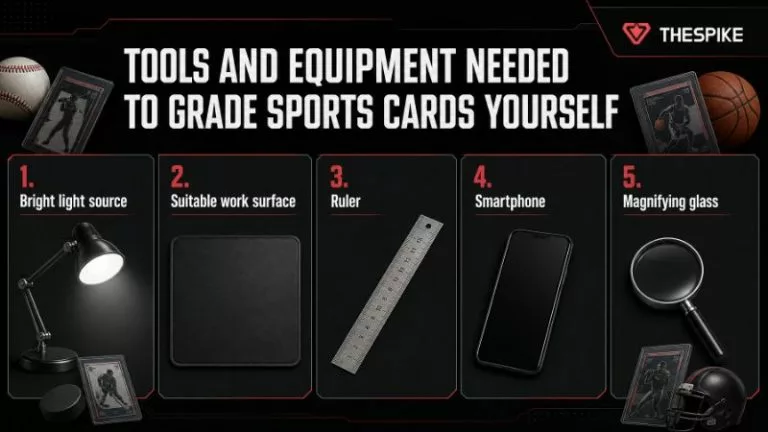
- Bright light source: Good lighting is essential for spotting flaws. A desk lamp or LED head torch with a cool white light works well.
- Suitable work surface: A microfiber cloth, felt mat, or similar surface helps protect the card while you handle and inspect it.
- Ruler: Useful for measuring the borders and determining how well the card is centered.
- Smartphone: Card grading and analysis apps can help you assess a card’s condition and estimate its likely grade.
- Magnifying glass: Not essential, but useful for spotting small imperfections that may be difficult to see with the naked eye.
How to select sports cards to be professionally graded
You shouldn’t send sports cards off for professional grading just for the sake of it. Not every card is worth the cost. It’s better to be selective. Before submitting a card, ask yourself the following questions:
- What condition is the card in? Generally, it’s best to focus on grading cards that are in excellent condition and have a good chance of receiving a high grade.
- Is the card vintage, rare, or scarce? Condition isn’t always the most important factor to consider. Older, harder-to-find, and highly sought-after cards can be worth grading even if they’re unlikely to receive a high grade.
- How much is the card worth? Sometimes, the cost of grading may exceed the value of the card itself. Higher-value cards are better candidates, especially when the grading cost represents only a small percentage of the card’s market value.
- How much could it be worth after grading? Compare recent sales of graded and ungraded versions of each sports card to see whether grading could increase its potential resale value.
- Do you plan to sell the card? Professional grading can give potential buyers greater confidence in a card’s authenticity and condition. Also, graded cards often sell for more than ungraded ones.
How to grade sports cards yourself: A step-by-step guide
To grade sports cards yourself, you’ll need to inspect four key areas: centering, corners, edges, and surface.
Here’s how to do it:
-
Prepare your workspace
Choose a clean, well-lit area and place the card on a soft surface. Before taking it out of its sleeve or case, wash your hands and move any food or drinks out of the way. The last thing you want is to accidentally damage the card while you’re trying to grade it!
-
Check the centering
This is where a ruler comes in handy, as it can help you measure the borders more accurately. For a PSA 10, the image must be centered within approximately 55/45 on the front and 75/25 on the back.
-
Inspect the corners
Next, examine all four corners on both the front and back of the card. For a PSA 10, all four corners should be perfectly sharp, with no visible rounding, fraying, whitening, or wear. It’s best to use a magnifying glass to inspect each corner closely, as even small imperfections can affect the grade.
-
Examine the edges
Once you’ve checked the corners, the natural next step is to work your way around all four edges of the card, checking both the front and back. Again, look closely for any signs of wear, including whitening, chipping, fraying, or small nicks.
-
Inspect the surface
Finally, inspect the entire surface of the card on both sides. Good lighting is particularly useful here. Hold the card under your light and slowly tilt it forwards, backwards, and from side to side. This will help reveal any scratches, stains, or other flaws that could affect the card’s grade.
-
Estimate the card’s grade
Once you’ve inspected the centering, corners, edges, and surface, you should have a good understanding of the card’s overall condition and be able to make an informed estimate of the grade it may receive. If it’s virtually perfect, with even centering, sharp corners and edges, and no surface damage or imperfections, it’s reasonable to expect a PSA 10.
Some of the most sought-after graded cards in sports
To give you an idea of just how much a professional grade can increase a sports card’s value, here are some examples of sought-after rookie cards and how their ungraded market values compare with their PSA 10 values.
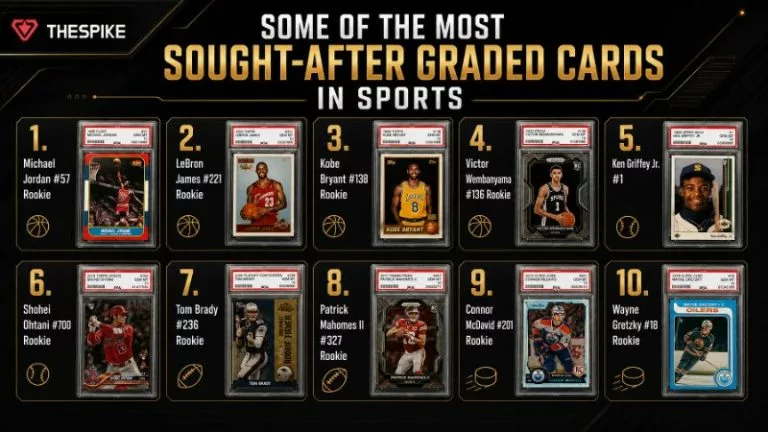
| Card | Set | Ungraded market value | Graded market value | Grading company |
|---|---|---|---|---|
| Michael Jordan #57 Rookie | 1986 Fleer | $4,500+ | $260,000+ (PSA 10) | PSA |
| LeBron James #221 Rookie | 2003 Topps | $650+ | $6,500+ (PSA 10) | PSA |
| Kobe Bryant #138 Rookie | 1996 Topps | $100+ | $2,300+ (PSA 10) | PSA |
| Victor Wembanyama #136 Rookie | 2023 Panini Prizm | $60+ | $330+ (PSA 10) | PSA |
| Ken Griffey Jr. #1 | 1989 Upper Deck | $110+ | $5,500+ (PSA 10) | PSA |
| Shohei Ohtani #700 Rookie | 2018 Topps | $120+ | $750+ (PSA 10) | PSA |
| Tom Brady #236 Rookie | 2000 Bowman | $2,500+ | $19,000+ (PSA 10) | PSA |
| Patrick Mahomes II #327 Rookie | 2017 Panini Donruss | $170+ | $1,200+ (PSA 10) | PSA |
| Connor McDavid #201 Rookie | 2015 Upper Deck | $690+ | $2,800+ (PSA 10) | PSA |
| Wayne Gretzky #18 Rookie | 1979 O-Pee-Chee | $700+ | $2 million+ (PSA 10) | PSA |
Alternative ways to get your hands on graded sports cards
Let’s face it. Inspecting cards yourself, submitting them to a professional grading company, paying the fees, and waiting for your cards to be returned can be a lot of hassle.
Fortunately, there are some alternative ways to get your hands on graded sports cards.
🛒 Buy Graded Sports Cards Online
One of the easiest ways to get graded sports cards is to buy them directly from online marketplaces. You can browse cards that have already been professionally graded, choose the exact card and grade you want, and have it shipped directly to you. It’s super convenient.
The main downside is that you’ll usually pay a premium for a pre-graded card, especially if it’s one of the most valuable sports cards in the market.
🎲 Try Card Rip Sites
Another way to get your hands on graded sports cards is through card rip sites. These sites let you buy and open mystery packs containing graded sports cards. The main appeal is the chance to pull a graded card worth significantly more than the price of the pack. However, there’s no guarantee you’ll pull a high-value card. What you get is randomly selected from a pool of both lower-value and higher-value cards.
You can review the potential cards and the odds of pulling each one before buying a pack, so you’ll have an idea of what you could get. Interested in giving it a try? Check out the banners on this page for a list of sites offering sports card rips.
Conclusion: Start grading your sports cards with confidence
Learning how to grade sports cards yourself is a valuable skill for any serious collector. The biggest benefit is knowing which cards are worth sending for professional grading. By assessing a card’s condition yourself first, you can avoid paying grading fees for cards that are unlikely to justify the cost.
It’s not difficult, either. With the simple tools and techniques covered in this guide, you can inspect your cards at home and get a good idea of the grades they might receive. Of course, you don’t have to grade cards yourself. If you’d rather skip the process altogether, you can buy cards that have already been graded or try to explore card rip sites.
You can use the banner links on this page to visit one of our recommended card rip sites, where you can pull graded cards from mystery packs.
How to grade sports cards yourself FAQ
🏅 Should I grade my own sports cards?
Yes. PSA even recommends checking a card’s condition before submitting it for professional grading. Doing so can give you a rough idea of the grade it might receive and whether it’s worth the fee.
📏 How do you grade baseball cards yourself?
You can grade baseball cards yourself by assessing four key areas: centering, corners, edges, and surface condition. A PSA 10 card should have even centering, sharp corners, clean edges, and a flawless surface with no scratches, marks, or other visible imperfections.
🔍 How reliable is it to grade sports cards yourself?
By using the tools and techniques we’ve covered throughout this guide, you can grade a card yourself and get a reliable idea of its condition. That said, there’s no way to guarantee the exact grade a professional grading company will assign to your card.
💰 Is it worth getting sports cards professionally graded?
It depends on the card and the grade it’s likely to receive. If it is unlikely to receive a high enough grade to justify the cost, sending it for professional grading may not be worthwhile. That’s why it’s worth learning how to grade cards yourself before paying for professional grading.



Play Packed
4.6/5


Play Packed Promo
100% Buyback
T&Cs apply
4.6/5
More Card Rips Articles
Our Team
Editor
Close

T&Cs and 18+ apply

T&Cs and 18+ apply

T&Cs and 18+ apply