
Home
Best Prediction Market Platforms 2026
Kalshi vs Polymarket Comparison 2026
Contains commercial content
Kalshi vs Polymarket Comparison 2026: Which Prediction Market is Better?
Last Updated on 05.11.2026
Kalshi vs Polymarket: Which one is better? As experts, we’ve weighed up the pros and cons of the two largest prediction markets in the US so that you can decide which one is right for you.
Kalshi was the first purpose-built prediction market website in the US and was a pioneer in peer-to-peer event contract trading. On the other hand, Polymarket began as a crypto trading app, but launched its CFTC-regulated prediction markets through its Polymarket US app. Polymarket has lower taker fees and offers rebates to market makers, while Kalshi’s fee structure is more complex.
Compare Kalshi and Polymarket Prediction Market Offerings


We recommend

3.8/5
- 10+ event categories
- Live trading
- Live data graph
Kalshi Promo Code
Trade $25 Get $55
T&Cs and 18+ apply
Copy
Deposit Methods








Withdrawal
0 – 3 Days
Apps
License

Show More
Table of Contents
- Kalshi vs Polymarket comparison
- Polymarket vs Kalshi – The pros and cons
- Kalshi vs Polymarket: differences in platforms, regulation, and availability
- Kalshi vs Polymarket: volume and market diversity
- Kalshi and Polymarket account funds; deposits, withdrawals, and trading currency
- Buying event contracts on Kalshi and Polymarket
- Kalshi vs Polymarket: trading fees
- Kalshi vs Polymarket arbitrage
- Polymarket or Kalshi – The final decision
- Kalshi vs Polymarket FAQ
Kalshi vs Polymarket comparison
Kalshi and Polymarket are the two biggest prediction markets in the United States, with the two behemoths constantly fighting it out for the number one spot. But how can you decide which one of these platforms to join?
While there’s not much to separate them in terms of user base, liquidity, and market diversity, each site has its own individual strengths and weaknesses. For instance, Kalshi is better for fiat deposit methods and trading event contracts in USD, while Polymarket is more crypto-friendly.
Before we take a more forensic look at what each site has to offer, here’s a comparison table covering the key metrics:
| Kalshi | Polymarket | |
|---|---|---|
| 👮♀️ Regulation: | CFTC | CFTC |
| 📈 Prediction markets: | Sports, politics, economics, crypto, and more | Sports, politics, economics, crypto, and more |
| 🏧 Payment methods | Cards, ACH, e-wallets | Crypto only |
| 💲 Trading currency: | USD | USDC |
| 💰 Max taker fee per 100 contracts: | $1.75 | $1.74 |
Polymarket vs Kalshi – The pros and cons
Here are the main advantages and disadvantages of each site that we’ll focus on in more detail below:
Kalshi: Pros and Cons
- 24/7 support
- Fiat and crypto payments
- Responsive mobile app
- Possible location-specific restrictions

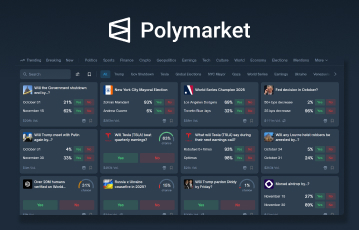
Polymarket: Pros and Cons
- Two downloadable apps.
- 7 different prediction categories.
- Superb trade volume and liquidity.
- Low trading fees.
- The desktop filters are poor.
- Limited promotions.
Kalshi vs Polymarket: differences in platforms, regulation, and availability
Kalshi operates as a Designated Contract Market (DCM) that offers prediction market trading through event contracts. Meanwhile, Polymarket offers access to prediction markets via its Polymarket US app.
Both platforms are overseen federally in the United States by the Commodity Futures Trading Commission (CFTC). As a result, they are technically available to verified US citizens and residents aged 18+ in most US states.
However, some sites have outright or partial unavailability in certain states. The landscape is moving quickly in this respect, so we recommend that you consult the platforms’ Terms of Service for current updates.
Kalshi vs Polymarket: volume and market diversity
Since their inception, Kalshi and Polymarket have consistently overtaken each other in terms of trading volume. Both sites have reported monthly trading volume figures of between $3 billion and $ 4.4 billion. As explained in our Kalshi vs Robinhood, these figures put Kalshi and Polymarket way ahead of the pack and in a league of their own.
For you as a trader, this means that market liquidity is unlikely to ever be an issue, especially for popular prediction markets like NFL sports games and US elections. However, even for niche markets such as overseas GDP, you’ll regularly find trading volume reaches six-figure sums.
Both sites have a large and diverse selection of prediction markets, covering categories like sports, culture, politics, economics, and more. While Kalshi is probably a bit better with the traditionalists, mainly related to high-profile sports events and US elections, Polymarket stands out for crypto prediction markets.
For example, Polymarket is the only platform that offers 5-minute cryptocurrency prediction markets for BTC and other blockchains, stablecoins, and altcoins.
Kalshi and Polymarket account funds; deposits, withdrawals, and trading currency
This is one area where the two platforms are distinctly different.
💵 Fiat Funding at Kalshi (USD)
As explained in our main Kalshi review, this app is better for the traditionalists, as all of the event contracts are settled in USD, with deposit and withdrawal methods being almost entirely fiat-related. Here are some of the deposit and withdrawal methods that are accepted (please note some may be unavailable in your state):
- Debit cards
- ACH bank transfers
- Apple Pay
- Google Pay
- PayPal
- Venmo
🔗 Polymarket Runs on the Polygon Blockchain
In contrast to Kalshi’s fiat currency model, Polymarket’s trades are executed in USDC, as the site runs on a Polygon-based cryptocurrency wallet. While you can fund your account using USD, you have to do so by purchasing cryptocurrency through regulated third-party brokerages.
Prediction Markets Promo
3.8/5

Prediction Markets Promo
3.8/5
Trade $25 Get $55
Signup Promo
|
T&Cs and 18+ apply
Copy
Buying event contracts on Kalshi and Polymarket
On both platforms, event contracts cost between $0.01 and $0.99 in the lead-up to the future event. Once the event has passed and the prediction market is resolved, the contracts tied to the correct outcome close at $1.00, with all incorrect event contracts closing at $0.00.
Both platforms offer you the option to buy in contracts and dollars, and place limit orders with a maximum price limit to prevent slippage. On Kalshi, the limit order option has a few more options, including time limits. If the executed price doesn’t meet your limits within the time frame, the trade is automatically cancelled.
Kalshi vs Polymarket: trading fees
On balance, Polymarket is the more favorable option when it comes to taker trading fees, as there are fixed taker fees by category, ranging from 0.04 to 0.07 per contract for most markets. Meanwhile, there are certain geopolitical markets with no taker fees at all.
If you place trades that don’t have a counterpart, you can get a maker rebate of up to 20% if someone takes the trade. This acts as a reward for adding liquidity to the market.
On the other hand, Kalshi has a complex tier fee structure where you can pay anything up to $1.75 per 100 event contracts. Rather than rebating market makers, the fees are usually 50% lower than the taker fees, and occasionally waived completely.
Kalshi vs Polymarket arbitrage
There is nothing in the rules on Kalshi or Polymarket to stop you from placing cross-platform arbitrage trades. This involves buying opposing outcomes on either platform. In other words, if you bought “Yes” contracts on Kalshi, you’d buy “No” on Polymarket so that you get a payout no matter what happens.
However, this is extremely risky, especially because the event contract prices move very quickly on many prediction markets. This means that by the time you’ve placed your trade on one site, the price on the other outcome could have moved, or the order won’t execute quickly enough, giving you two uneven trades.
As well as slippage, you also have to consider that the two platforms have different fee structures that need to be factored in when calculating your potential profits from a trade. At the end of the day, it’s a strategy that we’d advise against unless you’re a very experienced event contract trader.
Polymarket or Kalshi – The final decision
To summarize, Kalshi and Polymarket are the two biggest prediction market platforms in the US by quite a distance. Both are CFTC-regulated and are available to users aged 18+ in most of the US. However, there may be outright or partial restrictions in some states, so check to see if the platforms are available where you are first and foremost.
For many people, it will be a toss-up or a matter of personal taste which is best, as both sites have high liquidity, a massive user base, and a user-friendly platform. Polymarket is slightly better for fees and offers maker rebates, which will appeal to some traders. However, if you’re not a crypto user, Kalshi could still be the best option.
Whatever you decide, take the time to understand the risks of prediction market trading before you get started. Once you’ve decided which one to pick, you can sign up by clicking the relevant promo banner on this page.
Compare the offers and features at Kalshi and Polymarket
Prediction Markets Promo
3.8/5
Trade $25 Get $55
Signup Promo
|
T&Cs and 18+ apply
Copy
- 10+ event categories
- Live trading
- Live data graph
Kalshi vs Polymarket FAQ
🤔 Is Kalshi or Polymarket better?
Kalshi and Polymarket are the two biggest prediction market sites, and it’s hard to say if one is definitely better than the other. Kalshi was a purpose-built event contracts exchange that executed trades in the US. Meanwhile, Polymarket operates on the Polygon network, so your deposits, trades, and withdrawals work in USDC.
💰 Does Kalshi have higher fees than Polymarket?
Yes, Kalshi’s fees are slightly higher than Polymarket overall. Taker fees at Kalshi can be up to $1.74 per 100 contracts, compared with a maximum of $1.74 on Polymarket, so there’s not a huge difference there. However, Polymarket has some no-fee geopolitical prediction markets and gives maker rebates, whereas Kalshi would still charge traders a reduced fee.
📊 Is Kalshi or Polymarket more popular?
The answer to this question changes periodically as the two sites are constantly knocking each other off the top spot. What we can say with certainty is that they are both streaks ahead of other US prediction markets in terms of popularity.
More Articles














Best Prediction Market Sites
More Prediction Market Guides
Our Team
Editor
Close
Don’t Miss Out on Our Best Offers

T&Cs and 18+ apply

T&Cs and 18+ apply