
Home
Kalshi Review
Kalshi Event Contracts Explained 2026
Contains commercial content
Kalshi Event Contracts Explained 2026: Trading, Pricing, and Payouts
Last Updated on 29.10.2026
It’s easy to trade Kalshi event contracts, and the site offers loads of them. You’ll find more high-liquidity and high-volume contracts in the sports and politics categories. Not so much with the other categories, especially crypto.
Contract prices are dynamic and are determined by trader sentiment, not Kalshi. If your prediction is correct, you’ll get $1 for each contract; if it isn’t, your contract will expire at $0. We like that the site’s trading fees are pretty competitive and that there are no fees for ACH deposits. That said, there’s a 2% fee for card deposits.
Table of Contents
- Predicting event outcomes at Kalshi isn’t rocket science
- You can’t skip the trading fees
- Pros and cons of trading contracts at Kalshi
- Sports and politics are the most active categories at Kalshi
- It only takes a couple of minutes and steps to get started
- 5 takeaways to note
- Conclusion – Sports and politics have the most high-liquidity event contracts
- Kalshi event contracts FAQs
Predicting event outcomes at Kalshi isn’t rocket science
Kalshi is a regulated prediction market where you can trade event contracts that are based on the outcomes of events in real time. You’ll do this by buying “Yes”/”No” contracts that’re framed as answers to event markets, which are presented as questions.
For context, let’s use one of the more active Kalshi election markets: Which party will win the US Senate?. It comes with two positions, and you’d buy a “Yes” or “No” contract based on whether you think the event will occur.
If you purchase a “Yes” contract, that means you believe that the Democrats would win the Senate. On the flip side, purchasing a “No” contract means that you didn’t think the Democrats would win. It’s quite easy.
Prices are determined by what traders think
Prediction market sites assess what traders think about the possibility of a given event’s outcome. The contract prices are linked to this probability, which is presented as a percentage (between 0% and 100%) or as prices between $0.01 and $0.99.
For instance, the “Democrats” position had a “Yes” contract that was priced at $0.66 and a “No” contract going for $0.35. Here’s the interesting part: Kalshi event contract prices follow trader sentiment.
So, if, for any reason, more traders think that the Democrats won’t win the US Senate, the price for the “No” contract increases and the price for the “Yes” contract decreases. It goes both ways, too.
That said, contracts always settle at $1 for correct predictions. They also expire at $0 if your predictions are incorrect.
Checking the spreads can help you measure liquidity
When trading contracts, you’ll be paired with a counterparty to your position. Let’s say you purchase a “Yes” contract on Democrats winning the US Senate. Kalshi will pair you with a trader who took a “No” position (note that the match isn’t always immediate). When paired, both contracts may add up to $1 before fees.
For context, let’s assume that the live quoted prices are for a matched pair of contracts. The sum of the “Yes” contract ($0.66) and the “No” contract ($0.35) is $1.01.
The extra $0.01 is known as the spread of the market, and it could be narrow or wide (in this case, it’s narrow). Markets with high trading volumes tend to have narrow spreads because there are lots of folks trading on both sides of the market. Such markets are good picks if you find them. That’s because the contract prices are less erratic, and you can change positions quickly without using up lots of your funds.
You can’t skip the trading fees
Kalshi also runs a fee-based trading model, so you’d have to pay a fee at some point. Here’s a quick look at those Kalshi fees that are tied to trading contracts. That way, you’d know what to expect if you decide to trade on the site:
💰 Taker Fees
These are the fees that you’d have to pay when your orders are promptly matched with others waiting on the order book. It’s a variable amount that’s charged on what you get from each contract.
The taker fee is calculated by the formula: round up (M x 0.07 x C x P x (1-P)). Here’s what the variables mean:
- P: The contract’s price in dollars.
- C: Number of contracts.
- M: Multiplier for each contract.
- Round up: Fee + contract cost are rounded up to the nearest centicent (0.01 of a cent).
Kalshi also states that for most markets, the taker fee range for 100 contracts is $0.07–$1.75. Based on our checks, the site’s taker fees are quite competitive when compared to other top prediction market sites.
🔧 Maker Fees
Some Kalshi markets may have maker fees that apply to resting orders. These are orders that you place, and because the site doesn’t promptly match them, they have to stay on the orderbook.
We like that you’re only required to pay the maker fee if the resting order is executed. Here’s the formula used to calculate it: round up (M x 0.0175 x C x P x (1-P)). The formula’s similar to what’s used to calculate taker fees, and it’s got the same variables. As with the taker fees, we found Kalshi’s maker fees quite competitive too.
💳 Transfer Fees
You can only trade contracts at Kalshi after making deposits. If your predictions come correct, you’d also be able to get a Kalshi event contract payout using your preferred payment option. The site supports several non-fiat and fiat payment methods; you might need to pay fees to use some of them.
Kalshi doesn’t charge fees for ACH transfers, but you’d have to pay a 2% fee for debit card deposits. The fees for wire transfers vary per bank, but you’ll need to pay a processing fee to a third party when making crypto transfers. As with the other contract-tied fees on this list, Kalshi’s transfer fees are also competitive.
Pros and cons of trading contracts at Kalshi
Here’s the part of this guide where we describe the upsides and downsides of buying and selling contracts at Kalshi.
Pros and Cons
- Competitive trading fees
- Trader-determined contract prices
- Lots of markets available
- Possible location-specific restrictions
Sports and politics are the most active categories at Kalshi
You can trade contracts in 10 event categories at the site. That said, here are the more popular event categories, with the sports and politics categories having the most trading activity:
| Event category | What it features |
|---|---|
| Sports | 18 sports, including basketball, football, esports, darts, and baseball. There are thousands of Kalshi sports markets, many of which offer high liquidity. |
| Politics | Many US local politics and international political events. You’ll find lots of markets with high trading volumes here. |
| Culture | Movie ratings, Netflix movie views, reality shows, celebrity streams, and Billboard Hot 100 rankings. Has mid-level activity. |
| Economics | Gas prices, employment rates, Fed decisions, and international central bank decisions. Has mid-level activity, too. |
| Crypto | Limited range of markets on nine cryptocurrencies, such as BTC, ETH, SOL, and DOGE. |
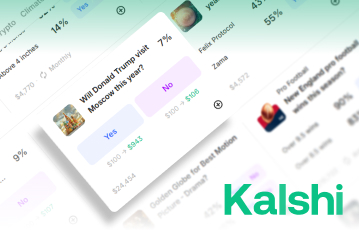
Join the world of Kalshi
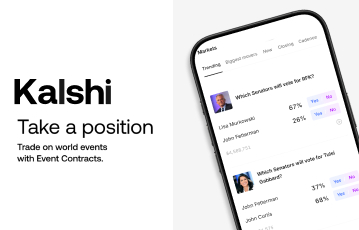
Trade on a variety of event contracts with Kalshi
It only takes a couple of minutes and steps to get started
Before signing up at Kalshi, remember to check if it’s available in your location. If you meet its eligibility requirements, take these steps to get started:
-
Click on the on-page banners to visit the official Kalshi website.
-
Hit the “Sign Up” tab at the top of the page.
-
Follow the prompts to complete the sign-up process.
-
Verify your account.
-
Fund your account (the minimum deposit is $10).
-
Head over to the homepage.
-
Click on the button featuring your preferred event category.
-
Scroll down the category page and take a good look at the event cards. Check the trading volumes and probabilities.
-
Click an event card with a market you’d like to trade, and that’ll take you to the market’s page.
-
Go over the market rules, chats, and download the price history so you can make an informed decision before trading.
-
Purchase a “Yes” or “No” contract and wait for the event to settle.
-
Request a payout if your prediction is correct and you want to bag your funds.
We’d recommend that you check out the site’s educational resources for more info on how the site works. It’s also a great idea to stick to a budget and to trade responsibly. You might want to share your Kalshi referral code with friends for a shot at claiming referral rewards. That way, you could get more bonus credits to trade with.
5 takeaways to note
Here are five takeaways that pretty much sum up this guide:
- Event contracts, including Kalshi sports markets, are priced between $0.01 and $0.99.
- Contracts settle at $1 for correct predictions and expire at $0 for incorrect predictions.
- The site’s taker and maker fees are relatively competitive.
- You can trade contracts in 10 event categories at the site.
- Politics and sports have some of the most active markets at Kalshi
Conclusion – Sports and politics have the most high-liquidity event contracts
Kalshi features 10 event categories where you can trade contracts on thousands of markets. Making correct predictions pays you $1 per contract, but you’ll get $0 if your predictions are incorrect.
The taker and maker fees aren’t fixed amounts, but they’re still competitive and won’t eat up your payouts. It’s nice to have fee-free ACH deposits, and the 2% fee on card deposits isn’t so bad.
So who should trade contracts at Kalshi? Well, that’d be anyone who enjoys predicting sports or politics-related event outcomes. Why? That’s because these event categories feature loads of high-liquidity and high-volume event contracts.
Kalshi’s also quite beginner-friendly, and new traders can easily find their way around its services. If you’d like to see things for yourself, hit the on-page banners and follow the prompts.
Kalshi event contracts FAQs
❓ What happens when my event contract expires at $0?
Kalshi’s contracts are cash-collateralized. So, you’ll only forfeit the amount you used in purchasing the contract if it’s incorrect and expires at $0.
📱 Can I trade event contracts on the go?
Yes, you can. Kalshi features a native app that’s compatible with iOS and Android devices. The site’s also fully optimized for mobile browsers.
🎰 What should I check for in an event contract before purchasing it?
Start with the market rules. Confirm the settlement date and the resolution source. You also want to check the trading volumes, live data graphs, and the chats too.
More Articles Related to Kalshi
- Kalshi Review 2026: Prediction Markets, Fees, Trading Features, and Legitimacy
- How Does Kalshi Work for Prediction Markets? Kalshi Trading Explained 2026
- Is Kalshi Legal in 2026? Regulation, Availability, and State Restrictions
- Kalshi Election Markets 2026: Event Contracts, Pricing, and Trading Explained
- Kalshi Fees Explained 2026: Trading Costs, Maker Fees, and Fee Structure
- Kalshi Prediction App Review 2026: Trading Features, Markets, Usability, and Safety
- Kalshi Referral Code 2026: Referral Offers, Rewards, and Requirements
- Kalshi Sports Markets 2026: Contracts, Pricing, Trading, and Payouts
Our Team
Editor