
Home
Kalshi Review
How Does Kalshi Work for Prediction Markets? Kalshi Trading Explained 2026
Contains commercial content
How Does Kalshi Work for Prediction Markets? Kalshi Trading Explained 2026
Last Updated on 30.10.2026
Most people want to know how Kalshi works before they put any money into prediction market contracts. And it works by buying a Yes or No position on real-world outcomes that settle at $1 or $0.
We’ve been trading contracts on Kalshi on things like Federal Reserve rate decisions, weather patterns, election outcomes and entertainment contracts. It works differently from a traditional brokerage because you trade against other traders on the exchange, rather than shares in a company. Contracts range from $0.01 to $0.99, awarding $1 if you’re right and $0 if you’re wrong.
Table of Contents
Kalshi is a regulated exchange where you trade against other traders
Our full review of Kalshi found it works more like a stock exchange than anything else, because you trade against other people on the site rather than against the house. You place an order and it gets matched with another trader on the other site, and prices move based on what buyers and sellers are willing to pay for a contract at any given time. The Commodity Futures Trading Commission (CFTC) approved Kalshi as a designated contract market, so it falls under the same federal oversight as futures exchanges, which is the main reason why you can trade on it with real money in the US.
Pros and cons of Kalshi
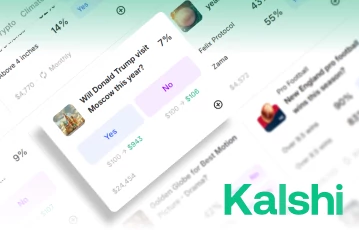
Pros and Cons
- Available in most US states
- ACH deposit minimum starts at just $10
- Sell a position before the outcome settles
- Low liquidity in some market categories
Every contract settles at $1 or $0
If you’re in a state where Kalshi is legal, the contracts on Kalshi are binary, so they’re straightforward once you understand how they work.
A contract pays $1 if you’re right
If you buy a Yes contract and your position is correct based on the contract rules, you’ll receive $1. If you’re wrong it settles at $0 and you lose the amount that you pay for it. The No side works in reverse, so there’s always a winner and a loser on every contract.
Contract prices reflect what traders think the probability is
If you take a position on a $0.70 contract, that implies there’s a 70% probability the market thinks that will happen. That comes specifically from the trading market rather than it being a forecast of whether the outcome will happen or not though. As orders change and new information comes in, the price shifts, which is the main reason why these markets are used as a signal for how likely something is to happen.
An example contract
Let’s say you buy 100 Yes contracts at $0.60 each on whether the Federal Reserve will cut its rates. The total cost of your contracts is $60 and if you’re right you’ll receive $100. That might sound like a decent profit, but remember the $100 includes your $60 back that you bought the contracts for. So the actual profit before fees is $40. If you’re wrong you lose the full $60.
You can sell a position before the outcome settles
You can choose to hold your position until settlement, but you can also sell some or all of your contracts to other traders.
📊 Early sales follow the same order types
If you want to get out early, a market sale will use whatever the available price in the market is. A limit sale lets you specify the amount and pick the minimum you’ll accept for the contracts. Using the earlier example, if you sell 100 contracts you bought at $0.60 for $0.75 each, it would return $75 and give you a $15 profit before fees. Vice versa, if you sell at $0.45, it will return $45 and will have cost you $15 before fees.
💰 The bid-ask spread limits what you can get
A sale needs a buyer on the other side though. And just because you’ve got a displayed buying price, it doesn’t mean it’s guaranteed to be sold. The bid is what buyers are offering and the ask is what sellers are looking for. The gap between them is called the spread, which can be bigger on less active markets and tighter on more popular ones.
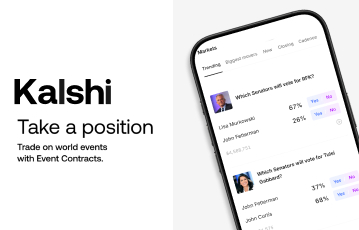
Buy and sell event contracts seamlessly
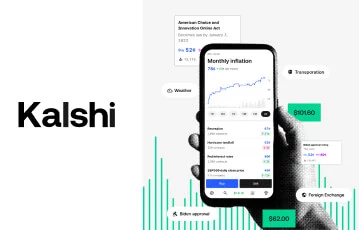
Explore Kalshi’s prediction markets today!
Transaction fees scale with prices
Kalshi fees apply whether you win or sell your position, and they can affect your profit even when you’re right about the outcome.
The taker fee formula charges more around the $0.50 mark
Kalshi has a taker fee formula of 0.07 × the number of contracts × prize × (1 – price). It sounds complicated, but it means you’ll pay more in fees when a contract is priced closer to $0.50, and less if it moves towards $0 or $0.99. Maker orders also carry fees, so we’d recommend you always check the fee table with each trade.
An example of how fees can change your profit
Since the formula can be confusing for first-time traders to Kalshi, here’s an example of how the fees can change your profit.
| Step | Amount |
|---|---|
| Contract cost (100 × $0.60) | $60 |
| Taker entry fee | $1.68 |
| Total entry cost | $61.68 |
| Winning settlement payout | $100 |
| Profit | $38.32 |
Start with the contract rules and work from there
We know there’s information overload here, but Kalshi is simple to understand after you’ve made a few trades. The basics are that every contract comes down to a Yes or No outcome that settles at $1 if you’re right and $0 if you’re wrong. Before you place your first trade, we’d recommend spending a minute reading the contract rules on the market so you know exactly what has to happen for your side to win.
If you’re ready to make your first trade on Kalshi, click one of the banners on this page to get started.
How Kalshi works FAQ’s
❓ How does Kalshi work?
Kalshi is a CFTC-regulated designated contract market where you trade event contracts against other traders.
📊 How do Kalshi’s event contract prices work?
Contracts are priced between $0.01 and $0.99, based on what buyers and sellers are willing to pay.
🔄 How does selling a position on Kalshi work?
You can sell your contracts before the outcome settles by using a quick order or a limit order. A quick order fills at the current available price and a limit order lets you set the minimum you would accept.
More Articles Related to Kalshi
- Kalshi Review 2026: Prediction Markets, Fees, Trading Features, and Legitimacy
- Is Kalshi Legal in 2026? Regulation, Availability, and State Restrictions
- Kalshi Election Markets 2026: Event Contracts, Pricing, and Trading Explained
- Kalshi Event Contracts Explained 2026: Trading, Pricing, and Payouts
- Kalshi Fees Explained 2026: Trading Costs, Maker Fees, and Fee Structure
- Kalshi Prediction App Review 2026: Trading Features, Markets, Usability, and Safety
- Kalshi Referral Code 2026: Referral Offers, Rewards, and Requirements
- Kalshi Sports Markets 2026: Contracts, Pricing, Trading, and Payouts
Our Team
Editor