



Home
Robinhood Review
Contains commercial content
Robinhood Prediction Markets Review 2026: Event Contracts, Markets, Fees, and Trading Features
Robinhood is not available at your location
Details
After my Robinhood prediction markets review, I can say the app is on point for mobile traders looking for multiple event contract categories. You get outcomes on major topics such as sports, climate, crypto, economics, entertainment, and politics.
But the thing is, you can’t trade on the website. To begin placing trades at Robinhood, you’ll need to download the app and complete the verification process. After that, you’ll be required to fund your account. Unfortunately, there are no sign-up bonuses or ongoing promotions specifically for prediction market traders. That being said, Robinhood has decent customer service.
Robinhood: Pros and Cons
- The app is simple to use
- Multiple customer support channels
- Encryption and biometric authentication are available
- You can only trade on mobile
- Deposit Methods
-



- License
-

- Owned By
-
Robinhood Markets, Inc
- Released
-
2013
- Homepage
-
robinhood.com
- Languages Supported
-
EN
- Support
-
Live Chat Feature, Telephone Number, E-mail Customer Support
-
support@robinhood.com
- Telephone Number
-
(650-761-7789
Last Updated on 28.10.2026
Table of Contents
- I didn’t get a welcome bonus
- No regular bonuses or loyalty program either
- Robinhood lists event contracts
- Expect to pay fees when you make predictions in the app
- I’d give the app 4 stars for usability
- Get the app on the Apple App Store and Google Play
- No crypto payment options, just fiat methods
- Support is available via live chat, email, and phone call
- Trader information is protected using encryption, and biometric authentication is available
- 13 event contract categories for traders
- Conclusion – Trade event contracts across 13 categories via the Robinhood mobile app
- Robinhood prediction markets review FAQs
I didn’t get a welcome bonus
Robinhood has no welcome bonus for prediction traders. No surprises there, because many other prediction markets don’t provide one.
The app’s available welcome offer gives you between $5 and $200 to put toward a gift stock. You can only claim it after you register and verify your account. But the offer has nothing to do with Robinhood prediction markets.
No regular bonuses or loyalty program either
Like the welcome bonus, Robinhood’s referral bonus is limited to stock trading. It gives you $5 – $200 in stock in any of the available companies, like Disney, Apple, Amazon, and Tesla. To get the bonus, you share your referral link with friends and get them to sign up through it. Once they do that, you can receive up to $5,000 in gift stock per year. However, this bonus is only useful for stock trading.
So my point here is that the app has neither regular bonuses nor a loyalty program for existing prediction traders.
Robinhood lists event contracts
Robinhood doesn’t allow prediction traders to do much on its website. You can only view the markets there. Its mobile app is the playground. It lets traders buy and sell event contracts on real-world topics such as crypto, sports, economics, and climate. Four major exchanges are behind these contracts: KalshiEX LLC, ForecastEx, LLC, Rothera Exchange and Clearing LLC, and North American Derivatives Exchange, Inc.
What you do with the markets is pick a side. When the contracts finally settle, and your prediction is correct, you receive $1 per contract. But if you’re on the wrong side, you get zilch. The good thing is you can close your position before a contract settles if you see prices changing.
About prices; they show how much traders believe an event will occur. A higher price indicates a higher implied probability. Still, they don’t guarantee how things eventually turn out.
Normally, the displayed probability and Yes price should match. But if they don’t, the percentage is likely showing the last traded price, whereas the Yes and No prices are live quotes from the order book. Yes and No prices may also not add up to 100¢ because of bid-ask spreads and liquidity.
Expect to pay fees when you make predictions in the app
It’s not free; Robinhood does charge you for trading predictions in its app. The brand has moved from a flat fee per contract and now uses a formula that takes the contract’s price into consideration. The fee is highest when the contract price is around $0.50 and lowest when it’s close to $0 or $1.
If you’re thinking about getting a lower commission, there’s a way around it. Just subscribe to Robinhood Gold, which reduces the percentage in the formula from 10% to 5%. The commission is rounded up to the nearest cent and capped at $0.01 per contract. The other exchanges it partners with may also charge an extra fee of up to $0.01 per contract. I totally recommend checking the Robinhood Derivatives fee schedule link for more information.
Before ending things here, Robinhood Gold is a paid subscription service for the app’s investment features. One benefit is lower commissions on event contracts. Whether you want to subscribe depends on how you plan to use the app.
I’d give the app 4 stars for usability
The fact is new traders can grab the Robinhood app and start trading predictions without needing to watch a “getting started” video. Creating my account was simple, and logging in only required my fingerprint.
At the top of the page, you get options like Build a Combo, Home, and Live. That section also features event contract categories: Climate, Crypto, Economics, Entertainment, and more. There’s also a search button to help you find specific events. When I wanted a list of BTC event contracts, I just typed “BT” in the search bar, and it pulled up six BTC event contracts plus a few others. It saves you from going on a wild-goose chase.
So how well does the app perform for live trading? Not bad at all. I traded live predictions several times and it let me see how quickly prices changed as traders responded to events. As long as my network connection was stable, I wasn’t stuck with a position I wanted to change. I also traded contracts before the events occurred without any lag.
Robinhood’s side menu features options such as Support, Security and privacy, and Settings. The app also flips between white and black backgrounds, so everything is easy to read. You’ll see fewer green texts throughout the app.
Get started with crypto on Robinhood
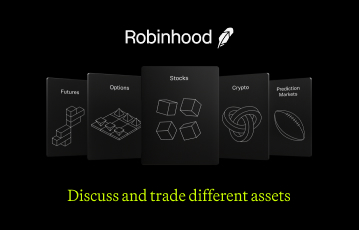
Discover multiple asset types on Robinhood
Get the app on the Apple App Store and Google Play
Robinhood’s lack of a functional website, for me, means I don’t get the broader view a desktop site would offer during trading.
From what the website looks like currently, there may not be much difference between using the app and the website if desktop trading becomes available. Still, I think a dedicated desktop version would be a good idea for traders who prefer a wider screen. You can get the app via Apple App Store or Google Play.
No crypto payment options, just fiat methods
I wasn’t completely disappointed with Robinhood’s payment methods since they work. But for an app like that to not have crypto?! It kind of leaves a lot to be desired. The available options include standard bank transfers (ACH and Non-Originated ACH), debit cards, wire transfers, and instant bank transfers.
If you’re depositing using a standard ACH transfer, you’re likely seeing your money in about 5 business days. Non-Originated ACH deposits take up to 4 business days. But the ones that get the job done way faster are debit cards and instant bank transfers. They take about 30 minutes. However, your bank still has the final say on timing.
Wire transfers become available the same day. Plus, none of these payment methods requires a deposit fee. The same methods are available for withdrawals. I like that Robinhood supports all of them, so you don’t have to worry about finding another way to withdraw your funds.
ACH and Non-Originated ACH withdrawals take a day to process through the app, though your bank’s policies may affect the timing. Debit card and instant bank transfer withdrawals are the quickest options, taking up to 30 minutes. Wire withdrawals can arrive the same day if you submit your request before 4 PM ET.
As for withdrawal fees, ACH withdrawals are free. However, debit card and instant bank transfer withdrawals incur fees ranging from $1 to $150. Wire withdrawals cost $25.
Robinhood may require you to complete some type of verification for certain payment methods, particularly debit card transfers. The verification process depends on your bank and may involve answering security questions.
Take this away also; your transfer limits and how often you can transfer funds also depend on your individual account.
Support is available via live chat, email, and phone call
Robinhood actually came prepared with customer support. You get live chat, email and phone options. My favorite still remains live chat though, since it’s available 24/7 whenever you need it.
When I started the chat, the virtual assistant answered my questions like a pro and responded within a minute. But after my first two questions, it immediately asked me to verify my account before continuing. So, if you’re using this channel, don’t play about your account verification from the start.
Upon verifying my account, I was allowed to ask questions at any time. I even made sure to ask on weekends and at midnight just to see if the virtual assistant would drop the ball. But nope, it was still on point with useful responses. If you prefer email support, replies may take up to 24 hours. However, the email assistance I received was just as helpful as the live chat responses.
If you want to speak with an agent, you can request a call to discuss your issue. But the wait depends on agent availability, though it’s usually less than 30 minutes. One thing I appreciate about Robinhood’s phone support is that it notifies you when you’re next in line and tells you which number it’ll use to call. That way, you don’t have to wonder who’s calling.
Where Robinhood falls a bit short for me is that phone support is only available from 7 AM to 9 PM ET. Also, not every inquiry even qualifies for it. I’d advise sticking to general questions when using this method. If you need help with your account, live chat is a better option.
The FAQ section is also packed with useful information on topics such as event contracts, accounts, payment methods, and taxes and forms.
Trader information is protected using encryption, and biometric authentication is available
On the regulatory side, Robinhood Derivatives, LLC has its act together. It’s a registered futures commission merchant. Remember, its event contracts come from KalshiEX LLC, ForecastEx, LLC, Rothera Exchange and Clearing LLC, and North American Derivatives Exchange, Inc. So, the question is are these prediction markets regulated? Yes.
KalshiEX LLC, Rothera Exchange, and North American Derivatives Exchange, Inc. are all regulated by the Commodity Futures Trading Commission (CFTC). ForecastEx, LLC has also been registered by the CFTC as a Designated Contract Market (DCM).
For account protection, I had to use my fingerprint to regain access whenever I hadn’t logged in for a few seconds. But there’s a second option of facial recognition as well. You can also enable a PIN as a backup authentication method. If you incorrectly enter your PIN three times in a row, you’ll automatically be signed out.
You must be at least 18 years old and have a verified account to trade Robinhood event contracts. Verification includes putting down your name, phone number, SSN, address, and employment information. You’ll also need to submit a photo of a recent utility bill to verify your address. Traders must reside in the US to use the app. However, those who reside in Michigan, Nevada, or Maryland cannot trade sports event contracts.
Since verification requires your SSN and other sensitive information, Robinhood states that it encrypts this information and transmits it through a secure TLS connection.
13 event contract categories for traders
Track market insights with Robinhood
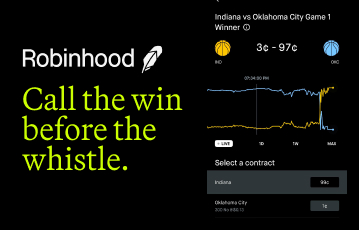
Stay ahead of the whistle with Robinhood
Traders have 13 major event contract categories to choose from on Robinhood. I’ll review each one:
-
Sports – Over 10 sports and combo feature
Robinhood offers event contracts on all the popular sports. Plus, it doesn’t just lump everything together under a general sports category. Instead, it lists individual sports. You’ll see NFL, college football, baseball, boxing, and chess. But that’s not all; you also get college basketball, Canadian football, esports, golf, MMA, NBA, NHL, WNBA, and racing. During my review, tennis and soccer had live events. So live trading is supported on the app.
I like the NFL subsections in particular. It features markets under Win Totals, Playoff Seeds, Awards, League Leaders, Season Stats, Team Specials, Next Team, Fantasy, Specials, and Draft. Some sports definitely have fewer prediction markets, though. For example, under Men’s College Basketball, the only market was Kansas Basketball – Next Head Coach.
For esports, Robinhood brings its A-game, again. It provides markets on LoL, CS2, Dota 2, Valorant, R6 and Overwatch. CS2 has the largest number of events, with more than 90 and Dota 2 has more than 25 events.
Another feature that I believe sports traders would like is Robinhood’s “build a combo” feature. This allows you to combine up to 10 predictions for supported events at a discount. If all of your predictions are correct, you’ll receive a payout of $1 per contract. If even one prediction in the combo is wrong, however, you get $0 across the board.
One more thing about sports: if you’re not eligible for Robinhood sports markets, you can simply click the settings button and select “Hide sports prediction markets.”
-
Climate – Four event contract subcategories available
The Climate category has four subsections: Hourly Temperature, Daily High Temperature, Daily Low Temperature, and Rainfall. The main draw is you can trade predictions on temperature and rainfall across several US states. But if you’re looking for markets on natural disasters or climate change itself, you might be disappointed. This category isn’t built for tracking long-term climate trends on the app.
Although each subsection has numerous markets, I think Robinhood could have included locations outside the US, as some sites do.
-
Commodities – Outcomes on gas prices, WTI, Brent Crude, and natural gas
Some gas price outcomes include US gas price tomorrow and US gas prices this week. Others focus on how high or low gas prices could get this year in specific US cities. Under WTI, Robinhood lists outcomes such as Oil Price (WTI) on specific dates, and Annual Return: WTI vs Brent.
The Brent Crude subsection features five outcomes. However, what grabbed my attention was the live market (Natural Gas 15 min). It felt similar to a crypto market.
-
Education – Trade event contracts on tuition
Contracts in this category focus solely on tuition fees. The available markets ask questions such as “What will Harvard tuition be?” “What will UCLA out-of-state tuition be?” and “What will Michigan out-of-state tuition be?” This category isn’t that popular on most prediction markets. So I think it’s one that gives Robinhood an edge over others.
-
Midterm – Find event contracts on House races for US states
If you’re into House race winners event contracts, this category won’t disappoint. Robinhood offers contracts on House races in every US state. Like “AL-03 House winner” and “CA-45 House winner.” You’ll also find prediction markets on broader midterm-related topics, such as “Which state will redistrict before the midterms?”
-
Elections – Trade predictions on presidential elections
Unexpectedly, Robinhood election markets come down to three subcategories: Presidential, Control of Congress, and International. The Presidential tab is all about the big US races; who wins the White House and who secures the Democratic nomination. Control of Congress lets you trade on which party takes the Senate and the House. The weak spot is International. It offers only a single market, so there’s not much to work with if you want to trade on politics outside the US.
-
Crypto – Outcomes on popular cryptocurrencies
Crypto is definitely one of the most well-stocked categories on Robinhood. It covers all the major assets: Bitcoin, Ethereum, HYPE, Solana, XRP, Dogecoin, and BNB. In the Bitcoin subsection, for example, you can trade 15-minute outcomes, and that same 15-minute market is available for each asset.
-
Economics – Event contracts on Fed rate, recession, and GDP growth
Some event contracts listed here also show up under Commodities. For example, the energy section lists markets like “How high will oil (WTI) get by a specific time?” That feels a bit redundant. Where it does get it right is with Fed, gas prices, economic indicators, GDP growth, and recession markets. A good example is “Recession this year?”
Also, I like that Robinhood includes international outcomes in this category. These include the Bank of Canada decisions and the Bank of Mexico decisions.
-
Financial – Event contracts on S&P, Nasdaq, treasury yields, and FX are available
You’ll get identical markets for the S&P and Nasdaq; mostly markets on how high or low the indexes will go. For FX predictions, Robinhood has questions such as “Euro to US Dollar Exchange Rate.” There’s also a Market Outlooks subsection, but it only offers one outcome right now: “Will credit card rate be capped this year?” One market alone makes it feel like Robinhood didn’t do enough here.
-
Metals – Outcomes on gold, silver, copper, platinum, and palladium
Robinhood leads with 15-minute outcomes in this category, including Silver 15 min, Palladium 15 min, and Copper 15 min. The Gold subsection covers outcomes on the gold price at specific times, and you’ll find similar markets under Silver, Copper, Platinum, and Palladium.
Personally, I’m happy with how many prediction markets are offered here.
-
Entertainment – Outcomes on TV shows, awards, music, and video games
Robinhood sure nailed its entertainment markets. It lists outcomes on Dancing with the Stars, Oscar Winners, Oscar Nominees, Grammy Winners, Grammy Nominees, TV, Movies, Rotten Tomatoes, Music, Music Streams, and Video Games.
Music Streams is another unique category I’ve seen on Robinhood. As a Tupac fan, I even traded predictions on 2Pac Streams for the year. Other markets include Ariana Grande Streams and Bad Bunny Streams.
-
Technology – Outcomes on AI, companies, science, and space
Some markets in this category focus on AI rankings and tech layoffs, with questions like “Best AI at the end of the year?” and “More tech layoffs?” The AI section felt a bit thin for Robinhood and needs more depth. You’ll also find science and space-related developments here, including “US grants license for new nuclear reactor?” and “Will the US confirm that aliens exist?”
-
Politics – Find event contracts on Trump, trade, fiscal matters, and policy
The Trump subsection also includes event contracts that aren’t directly about the US president. Examples include “Recession this year?” and “Kash Patel out as FBI Director?” To me, Robinhood could organize this section better, though it does offer interesting markets like “Who will leave the Trump administration in 2026?”
Other subsections under Politics include Trade, Fiscal, Policy, and International. The only international market available was “Who will lead Venezuela at the end of the year?”
Conclusion – Trade event contracts across 13 categories via the Robinhood mobile app
Robinhood gets high marks from me regarding the number of event contract categories it offers. Although a couple of the categories, Economics and Commodities, do overlap, I believe that there are still enough different options to allow for a variety of trades.
The availability and efficiency of the customer service channels are some of the things I would rate highly. Another area where Robinhood is doing well is security. The app uses TLS encryption and has a biometric login process.
A couple of drawbacks are the lack of promotions and limited payment options. It would be nice if it accepted cryptocurrencies. Still, I think Robinhood is an ideal option for traders who want to place trades on mobile. If that sounds like you, check out the Robinhood website by using the links around this page.
Robinhood prediction markets review FAQs
📞 What’s Robinhood customer support like?
It offers live chat, email, and phone support. Live chat is available 24/7 and phone support is available only during specific hours.
🖥 Can I trade predictions on the Robinhood website?
No. You can only view event contracts on the site. To start trading, you have to download the app, verify your account, and make a deposit.
⚽ Does Robinhood offer sports event contracts?
Yes, but access to sports event contracts is restricted for traders in Michigan, Nevada, or Maryland.
More Articles Related to Robinhood
Our Team
Editor