VCT 2026 Stage 1 viewership analysis: Record lows and shifting peaks compared to 2025
VCT 2026 Stage 1 delivered record lows across all international leagues outside of China, marking a clear downturn from VCT 2025 Stage 1 despite a few headline-grabbing peak matches. Compared to 2025, Western regions saw double‑digit percentage drops in key metrics, with EMEA hit hardest and Pacific relying on new demographics to stay afloat.
Global trend: from plateau to decline
Esports Charts reports that all 2026 Stage 1 international leagues except China recorded record‑low group‑stage viewership, with EMEA, Americas, and Pacific all down year‑on‑year, while China’s international watch time grew 13.2%. EMEA’s Stage 1 dropped to 8 million hours watched and under 180,000 Peak Viewers, with both metrics falling by more than 25% versus 2025.
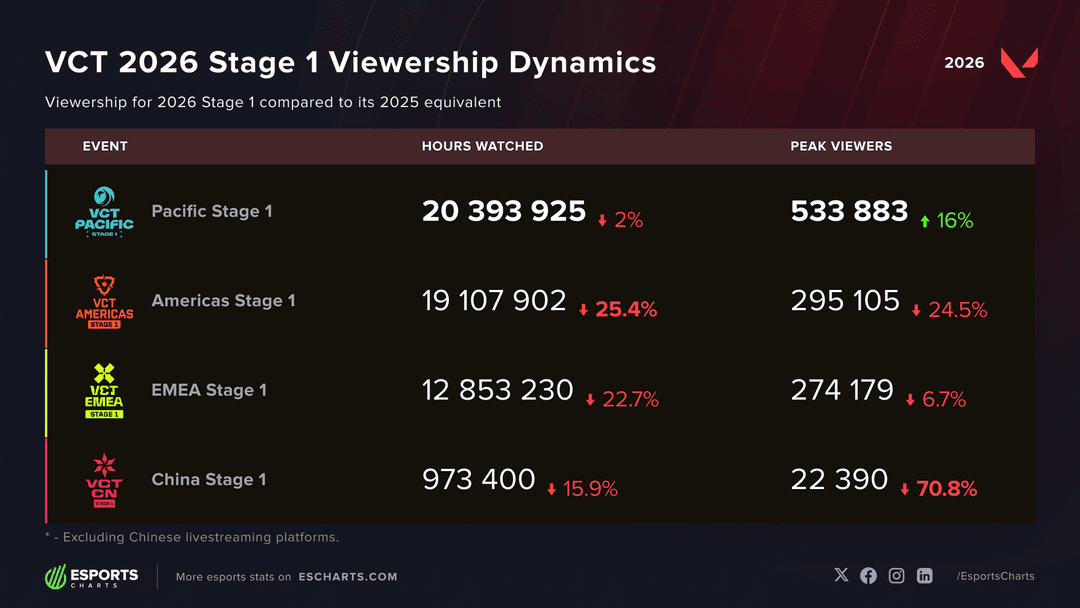
VCT 2026 Stage 1 Overall Viewership compared to 2025 (Image Source: Esports Charts)
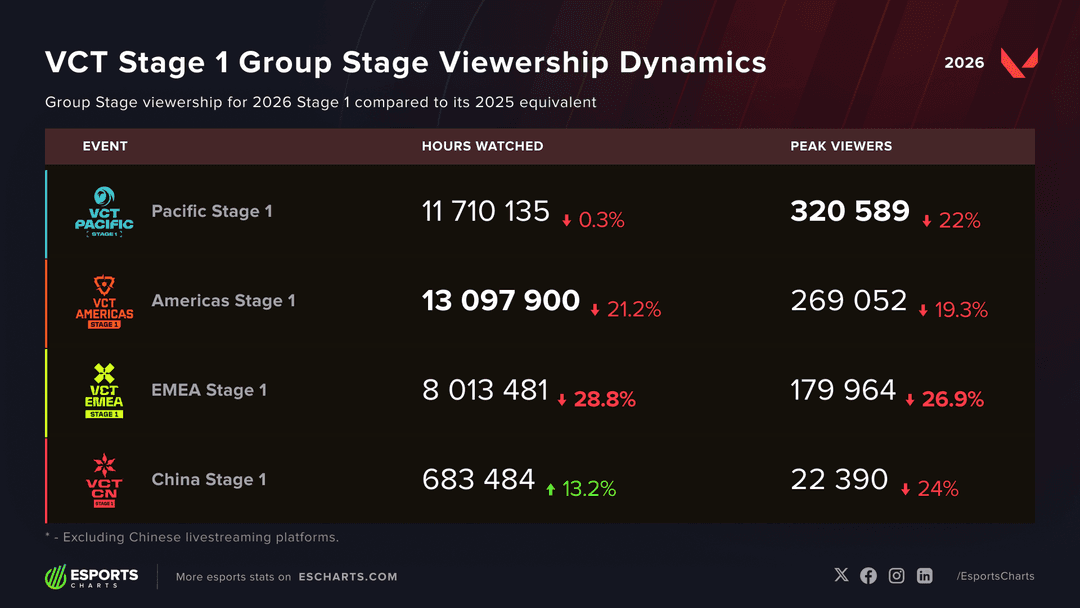
VCT 2026 Stage 1 Group Stage Viewership compared to 2025 (Image Source: Esports Charts)
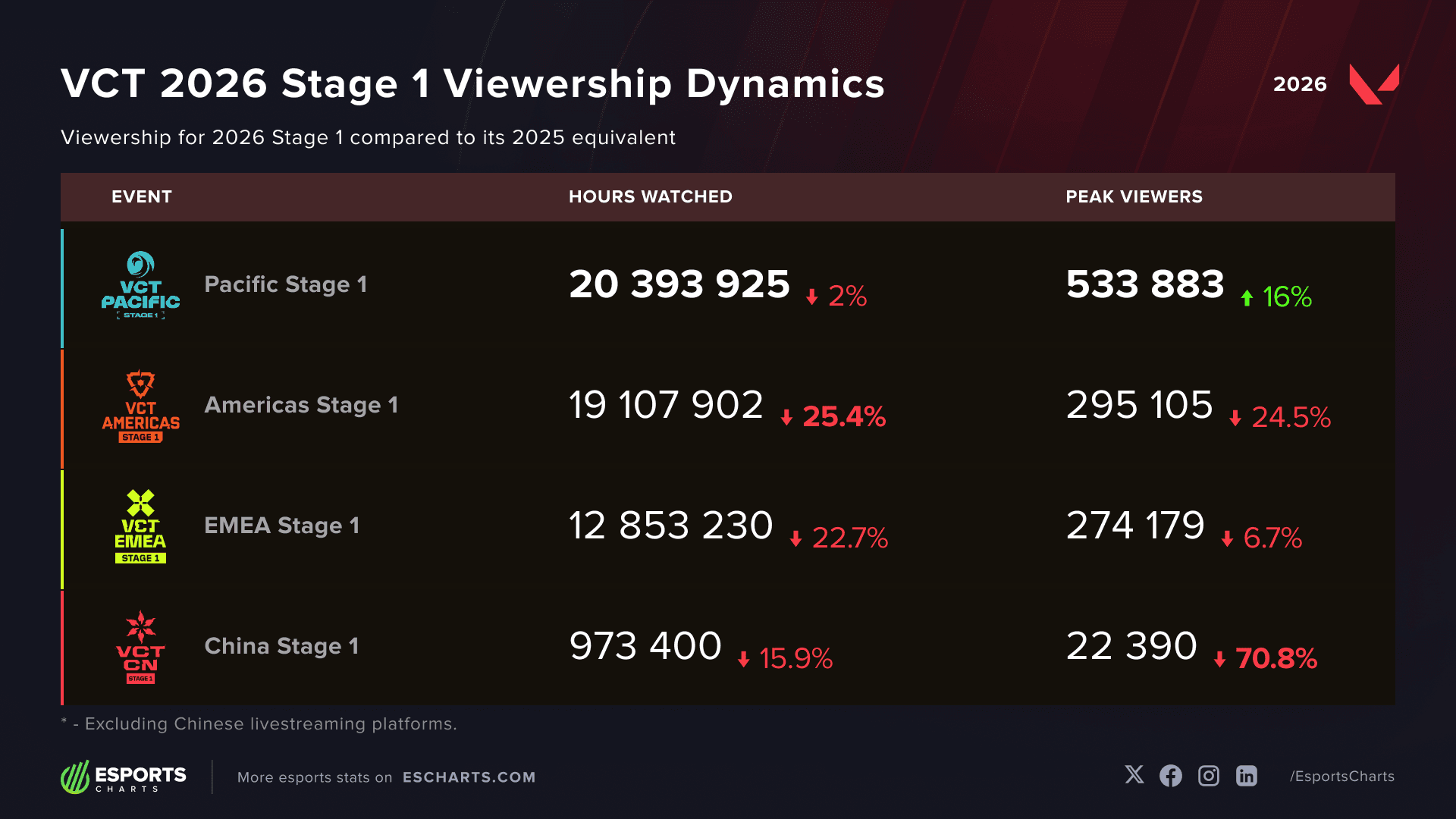
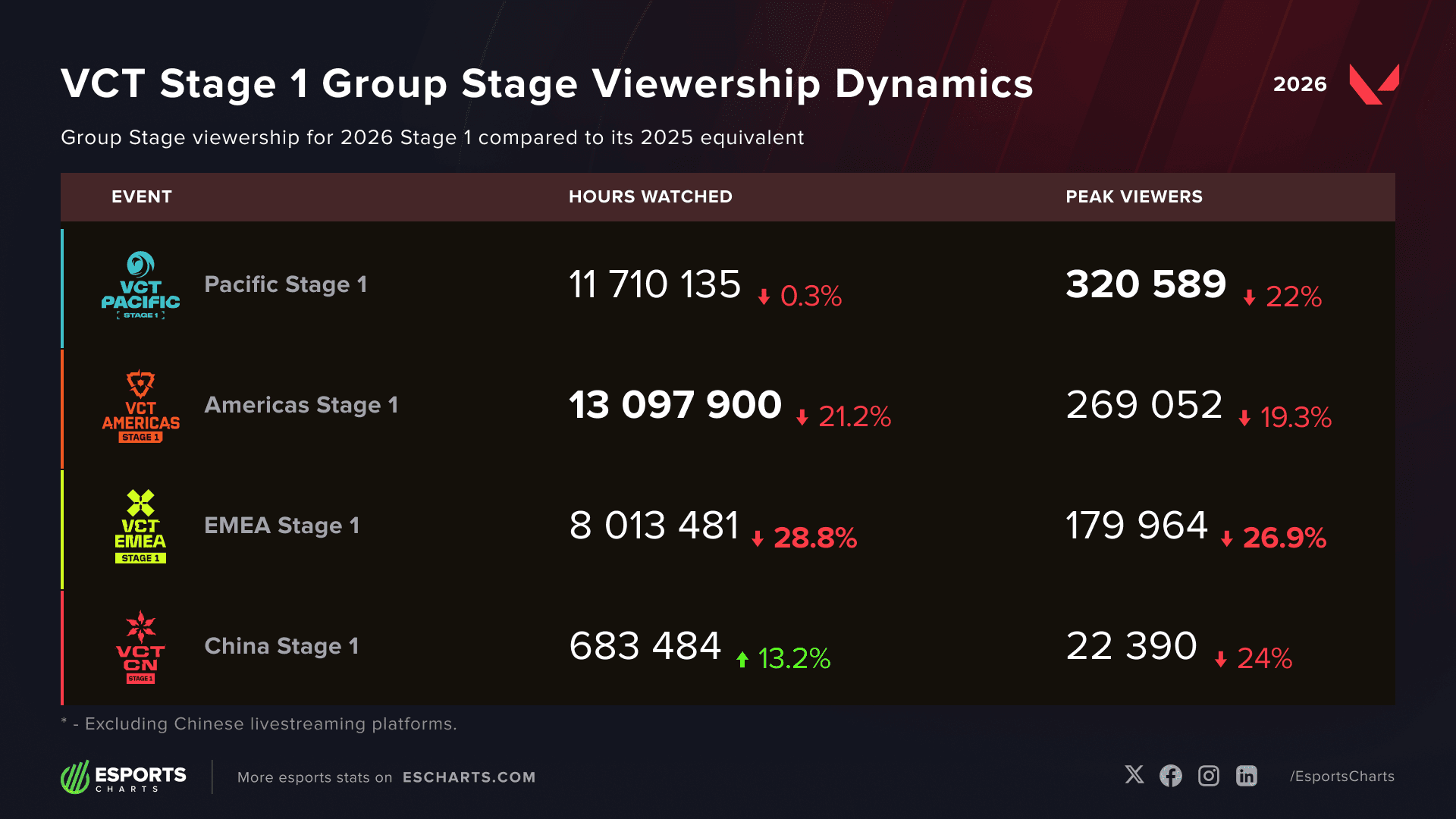
In 2025, VALORANT Champions Tour 2025 - Americas Stage 1 peaked at 390,841 viewers with 209,221 average viewers, while VALORANT Champions Tour 2025 - Pacific Stage 1 grand final reached 460,073 peak viewers, and VALORANT Champions Tour 2025 - EMEA Stage 1 hovered around a 246,100 peak with slightly under 125,000 average viewers. Against that baseline, the 2026 numbers reflect a sharp structural erosion rather than minor variance.
Americas: slipping from viewership king
VALORANT Champions Tour 2026 - Americas Stage 1 group stage saw Hours Watched fall by 21.2% and peak concurrent viewers drop 19.3% compared to 2025, making it the lowest Stage 1 group phase in the region’s history. Even with a 295,000‑viewer G2 Esports vs Leviatán grand final, the full 2026 Stage 1 is described as the least popular edition the circuit has produced.
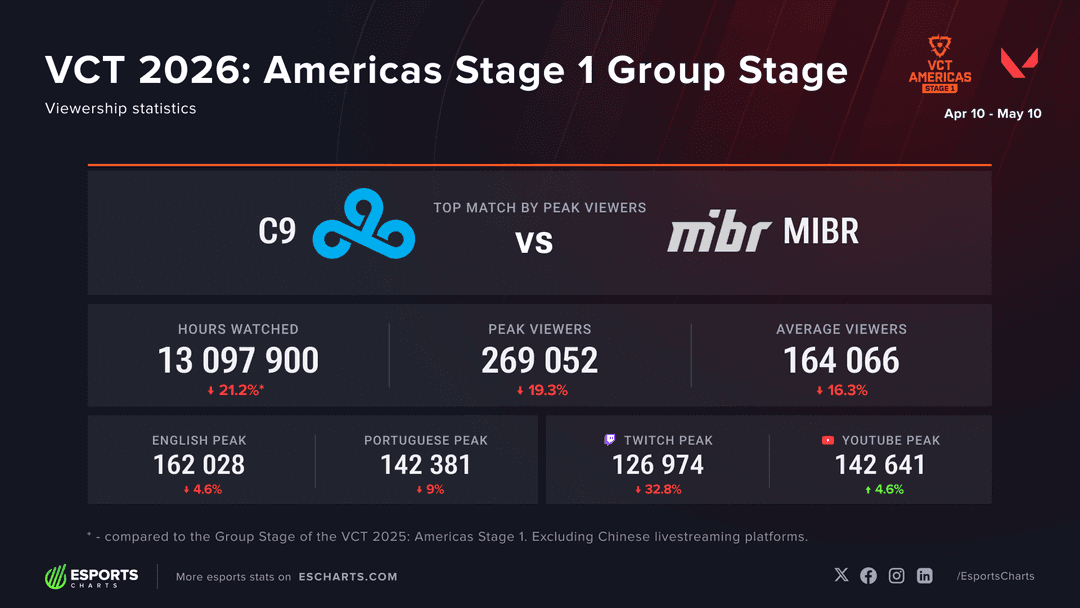
VCT Americas 2026 Stage 1 Viewership Statistics (Image Source: Esports Charts)
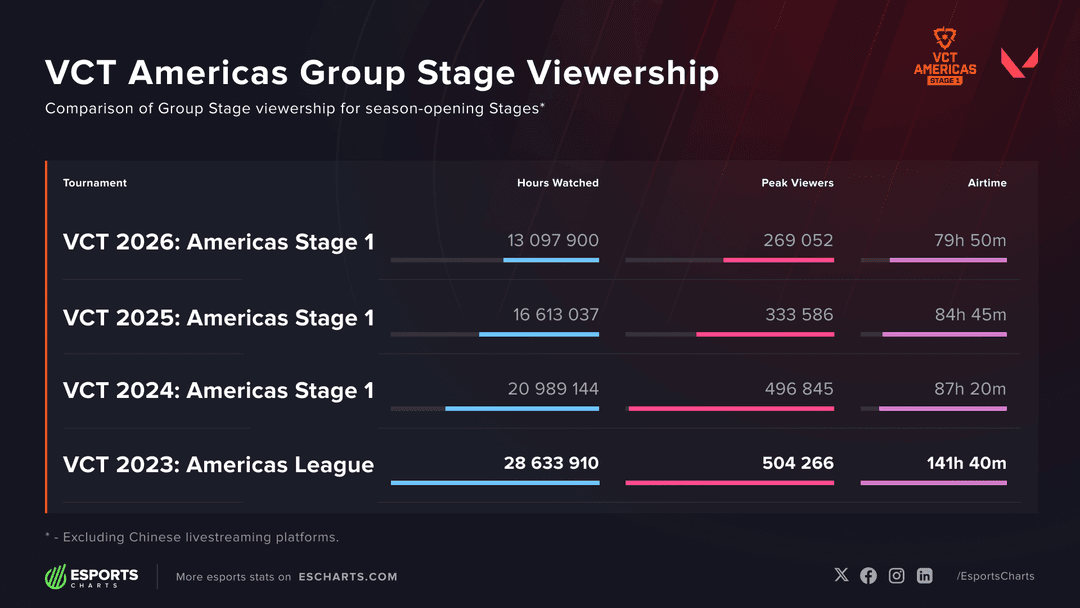
VCT Americas Viewership statistics over the years (Image Source: Esports Charts)
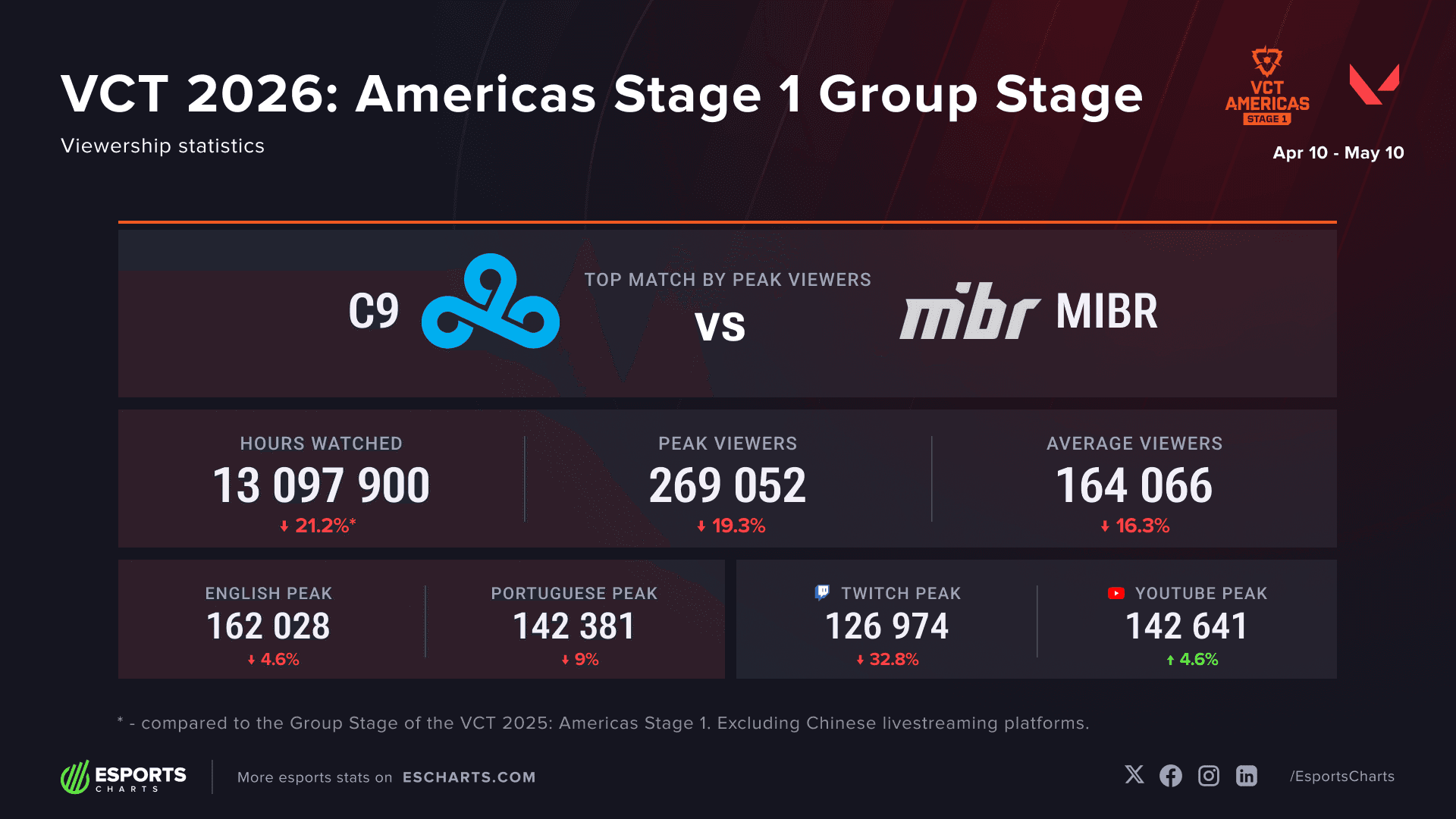
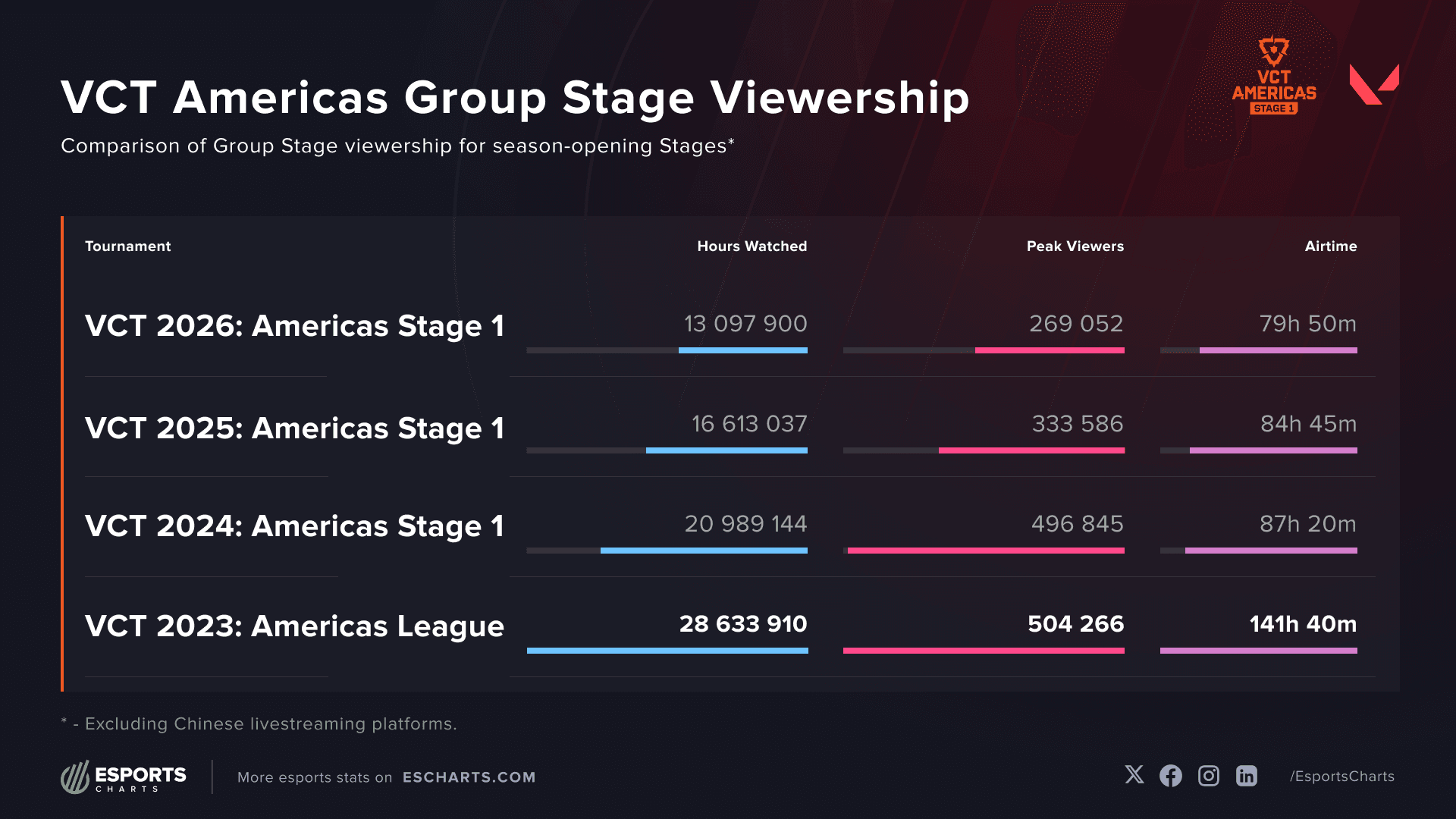
The early exit or outright absence of fan-favorite organizations like LOUD and Sentinels drained casual viewership, with the two teams failing to qualify for VALORANT Champions Tour 2026 - Masters London 2026 compounding the damage. By contrast, 2025’s Americas Stage 1 still leaned on Sentinels vs G2 and Sentinels vs MIBR as top draws en route to that 390k peak, highlighting how much star‑brand firepower has been lost in a year.
Pacific: record peaks, weaker foundation
Pacific retained the highest peak among the 2026 leagues, with Paper Rex vs Nongshim RedForce hitting over 320,500 peak viewers in groups and the FULL SENSE grand final surging to 553,883 peak viewers, a new series record and an all‑time Thai‑language record above 110,000. Yet the group stage hit an all‑time low in Korean watch time, just under 1M Hours Watched and down roughly 50% year‑on‑year, contributing to an 11.4M Hours Watched total that was 12.8% lower than 2025.
Across the full event, average viewers still declined by 5.3%, and Korean peak viewership fell by more than 107% compared to 2025, but this was offset by major growth in English, Japanese, Vietnamese and especially Thai audiences, with English peak up 41% and Thai peak more than doubling. In 2025, Pacific’s Stage 1 grand final drew 460,073 peak viewers, so 2026’s record peaks show that Pacific’s ceiling is rising even as its day‑to‑day engagement softens.
EMEA: deepest structural damage
EMEA suffered the steepest decline, with the VALORANT Champions Tour 2026 - EMEA Stage 1 group stage averaging under 100,000 viewers and posting an almost 30% year‑on‑year drop to 8M Hours Watched; its top group match, Fnatic vs Team Vitality, fell 26.9% to 180,000 peak viewers compared to 2025. Including playoffs, overall watch time for EMEA Stage 1 still dropped by almost 23%, even though Fnatic vs Team Heretics managed 274,000 peak viewers and the grand final reached 223,254.
Where 2025 EMEA could lean on French and Spanish co‑streaming giants like Kamet0, Squeezie, and mixwell to smooth over official-channel declines, those same creators saw severe drops in 2026, with mixwell’s average viewers more than halved versus 2025. Pacific’s playoff peak was almost 49% higher than EMEA’s, and unlike Pacific, EMEA failed to cultivate new local growth segments to replace its declining French, Spanish and English cores.
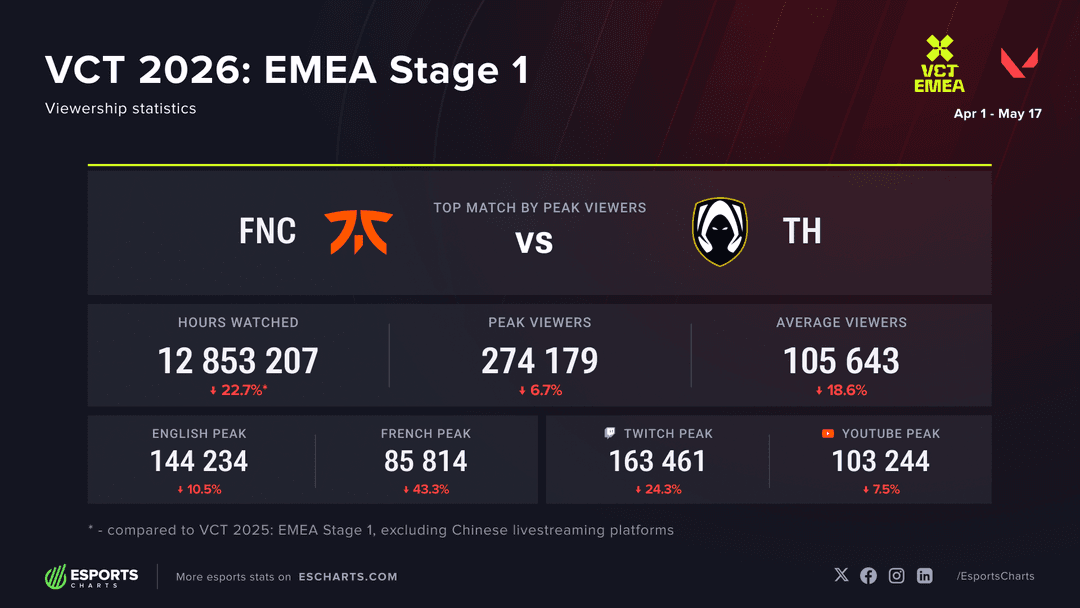
VCT EMEA 2026 Stage 1 Viewership Statistic (Image Source: Esports Charts)
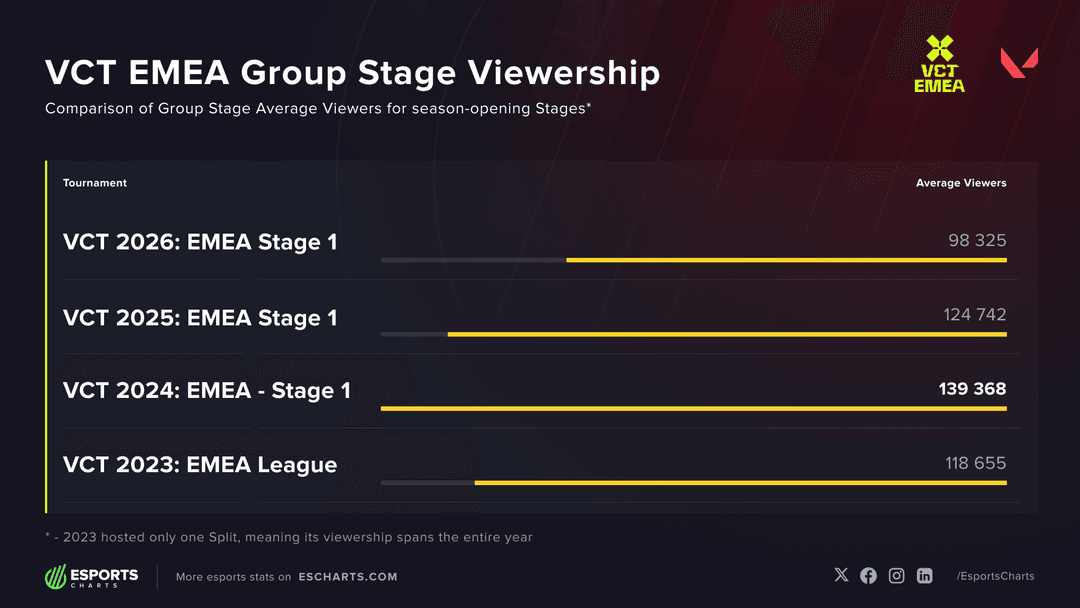
VCT EMEA Stage 1 Viewership over the years (Image Source: Esports Charts)
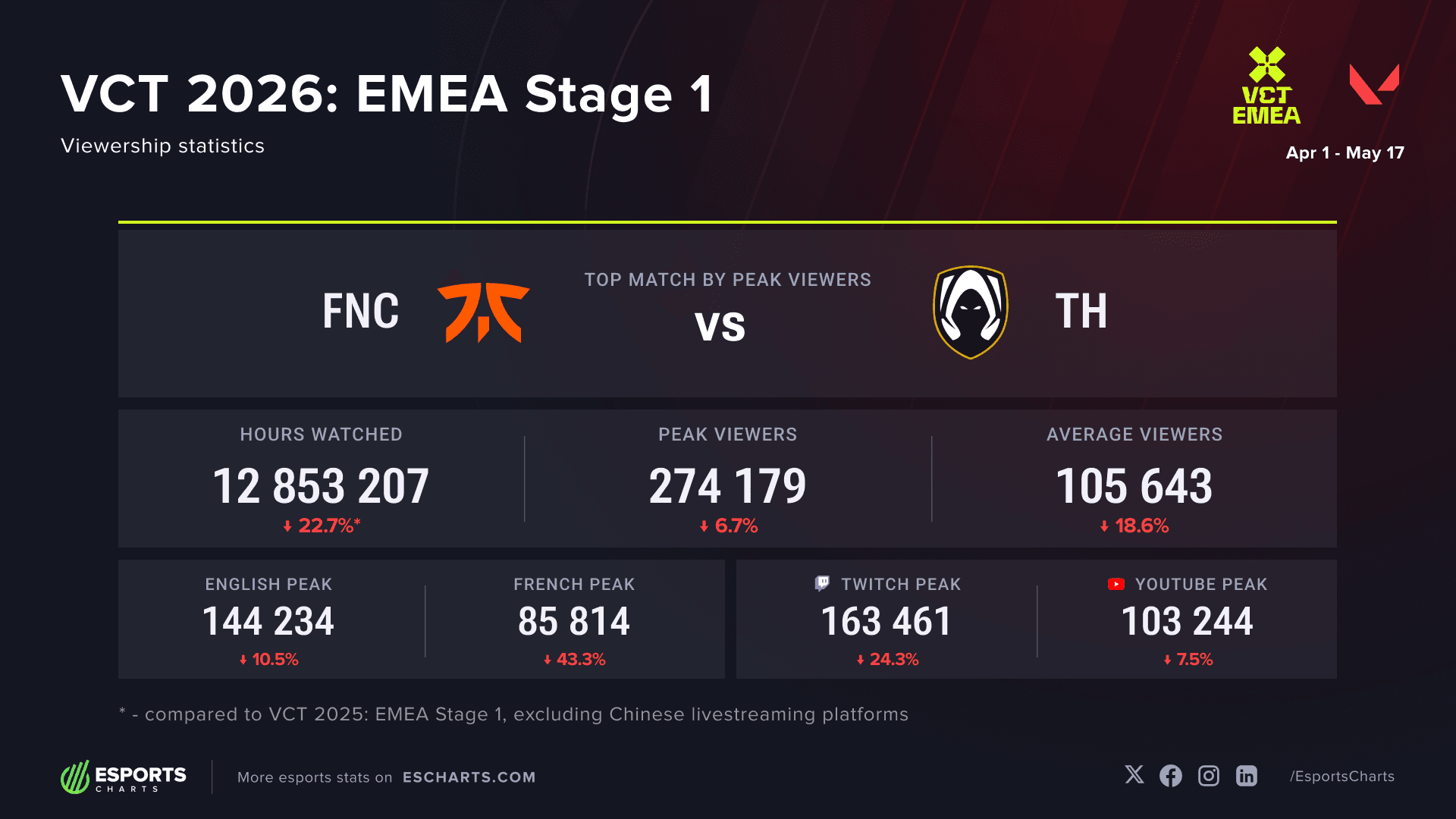
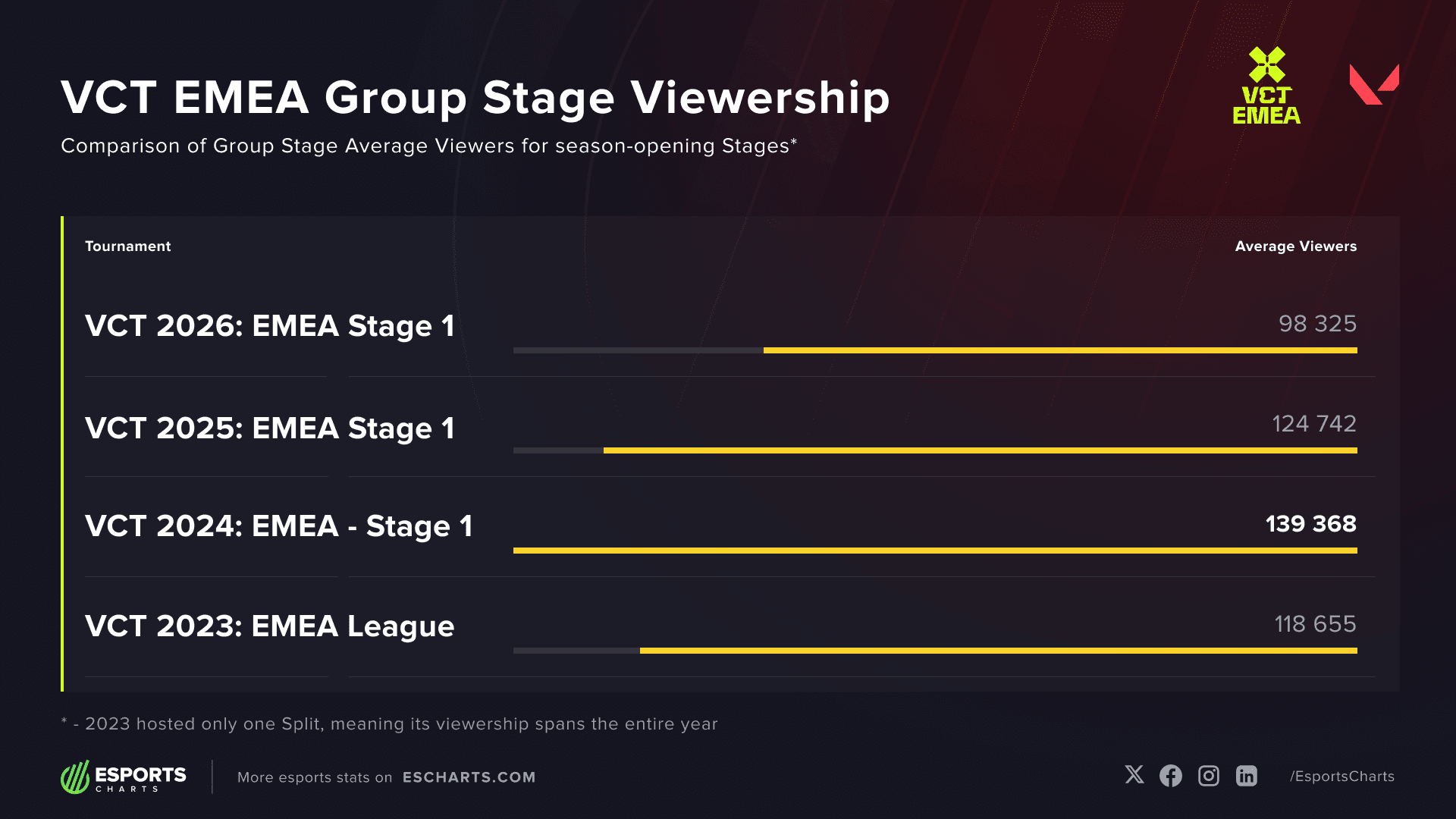
What changed between 2025 and 2026?
VCT 2026 Stage 1 laid bare a clear divide: leagues that leaned on a narrow base of superstar brands and co-streamers paid the price, while Pacific thrived by tapping into new Japanese and Thai audiences. Americas and EMEA saw their flagship teams underperform and their top influencers lose reach, dragging both peak numbers and baseline engagement well below 2025 levels.
Pacific's record-breaking grand final peaks are encouraging, but they also underscore how fragile the circuit's viewership model remains, heavily reliant on a few teams and personalities rather than broad, organic fanbases built to sustain the long haul.
If Riot and partnered organizations want to reverse this slide heading into Stage 2 and 2027, they will need to rethink scheduling, co‑streaming incentives, and regional storytelling to rebuild week‑to‑week engagement rather than relying on a few blockbuster matchups to carry the charts.
For all things VCT-related, make sure to stay tuned to THESPIKE.GG as we continue to update you with the freshest game and esports news.
Featured Image Source: Riot Games
Latest News
- VALORANT Champions Shanghai 2026 top performers by ACS, KD, and moreCheck out the top performers of VALORANT Champions Shanghai 2026 by ACS, K/D, Kills/Round, and HS%, from Kamo and Erde to Xeus and Tkzin.
 about 3 hours ago
 - Evil Geniuses to shut down all operations, entire VALORANT roster to be releasedAfter missing out on partnership for the VCT 2027 season, Evil Geniuses have announced they will cease all esports operations and release its entire VALORANT lineup.
 about 12 hours ago
 - Dambi to explore his options for 2027 after Nongshim RedForce miss partnershipVCT Masters Santiago champion Dambi announced he's exploring his options outside of Nongshim RedForce as the team misses out on the 2027 VCT Partnership Program.
 about 23 hours ago
Comments
vct 2023
For all information about the VCT 2023, check out our VCT Hub. There you will find our FAQ to answer all of your questions and details about the teams, different Leagues, and more.