LoL Fearless Draft explained: Rules, history and impact on pro play
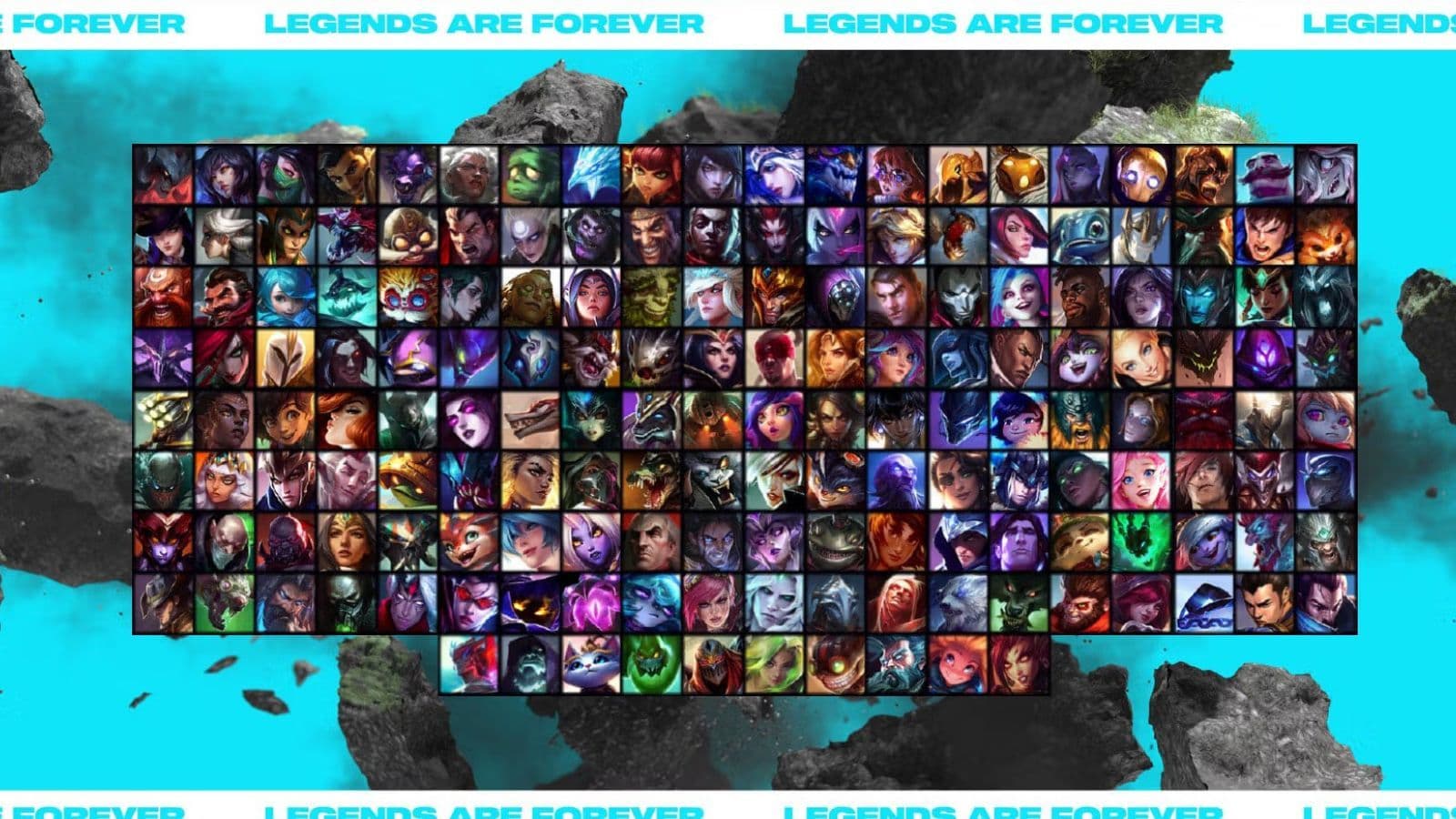
Fearless Draft is the biggest change to League of Legends drafting since bans were added. In 2025, it moved from tests in academy leagues to the center of the LoL Esports season. It appeared in regional and international competition, and this guide goes over everything you need to know about its history, current state, and future plans!
What is Fearless Draft in League of Legends?
Fearless Draft is a series-based draft rule. Once a team plays a champion in a best-of series, that champion is no longer available to that team for the rest of the series.
The basic idea is simple. Game 1 uses the normal pick/ban phase. From game 2 onward, every champion that a team has already played in earlier games is locked for that team. The other team can still pick it, depending on the exact version of the rules.
This system pushes teams to show more champions and more strategies every time the series goes longer.
During 2025, Riot repeatedly framed Fearless as a live experiment. The company collected draft data, champion diversity stats, and viewer feedback across First Stand, regional splits, MSI, and Worlds. During Worlds 2025, Riot confirmed that Fearless will return for the 2026 season. T1 became the first Worlds Champions after the new drafting system.
How it differs from the standard pick/ban system
In the classic system, teams can first-pick the same champion in every game if it is not banned. Strong meta picks show up constantly, and many series look similar from draft to draft.
Fearless Draft changes that pattern in three key ways:
- Champions are “one-and-done” for each team in a series.
- The available pool keeps shrinking as the series continues.
- Bans still exist on top of these “Fearless bans”, so some champions never show up at all.
This turns a best-of-three or best-of-five into a real test of champion pool depth, not just comfort drafts.
Why did Riot create Fearless Draft?
Riot wanted to deal with a problem that every long-lived competitive game faces. Pro players and coaches always solve the meta. The same strong champions appear every series, especially in important games.
Fearless Draft tries to fix that in three ways:
- It increases champion diversity on stage.
- It rewards players who master wide pools instead of three comfort picks.
- It keeps viewers interested, because game 3 rarely looks like game 1.
Riot already saw similar rules work in other titles, especially Arena of Valor’s “Global Ban Pick”, so there was a clear design template.
How Fearless Draft works in a best-of series
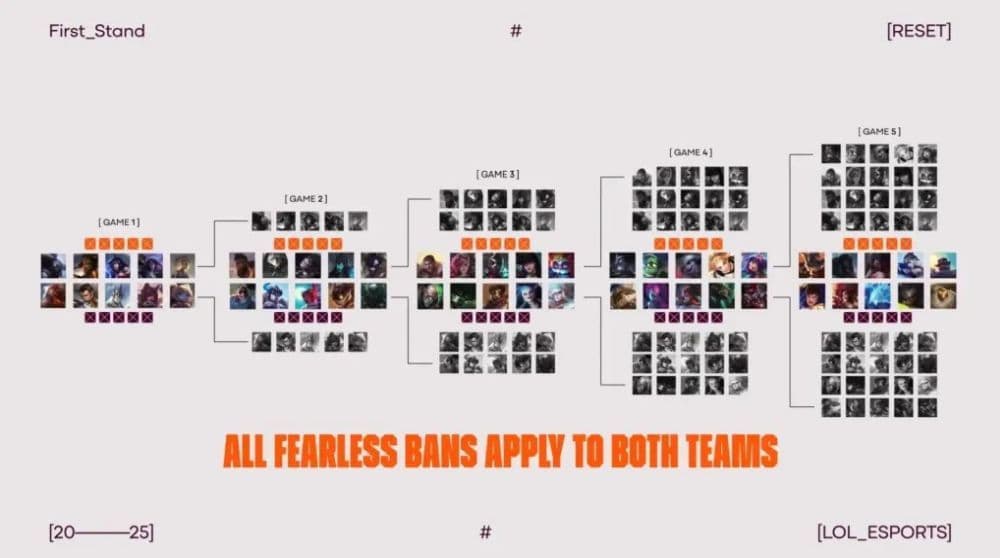
In pro play, Fearless sits on top of the normal draft. A simple best-of-five looks like this:
- Game 1: Normal draft. Both teams have access to the full champion roster, minus standard bans.
- Game 2: Any champion a team already played in game 1 is locked for that team. They can still ban it, but they cannot pick it.
- Game 3: All champions a team used in games 1 and 2 are now locked for that team. The list keeps growing.
- Games 4 and 5: The same rule continues. By late games, both teams work with a much smaller personal pool.
The exact lock rules depend on the type of Fearless used, which leads to the next point.
How bans work under Fearless Draft and how they stack
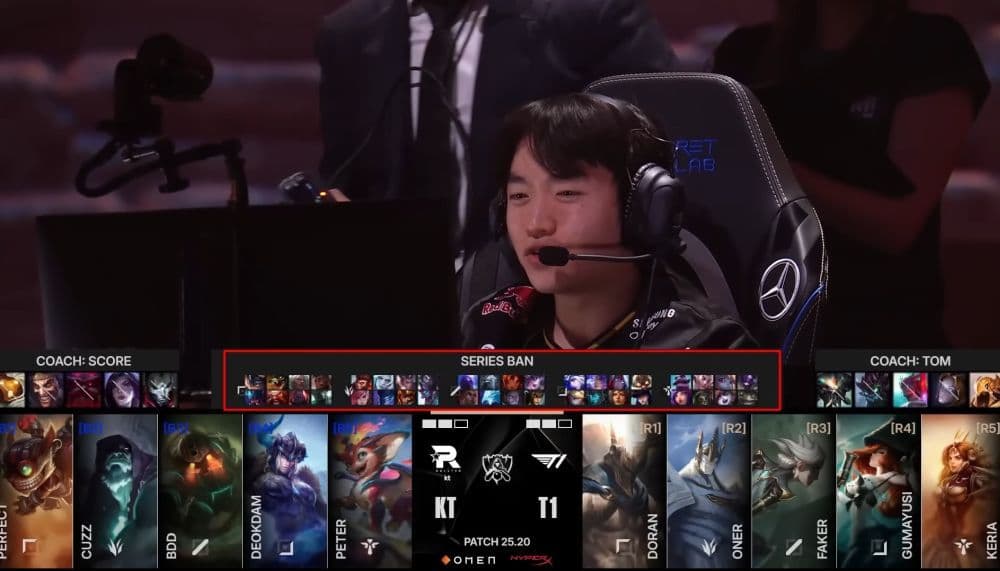
Fearless bans are not normal bans. They are automatic locks based on previous games. The standard ban phase at the start of each game stays the same.
In practice:
- Each game starts with 10 regular bans.
- Then the game also removes every champion that falls under the Fearless rule for that team or for both teams.
By game 3 of a long series, you often see over 30 champions that no team can pick anymore. Coaches need deep prep to stay ahead.
When was Fearless Draft first used?
Here is a quick look at the history of Fearless Draft being used in League of Legends:
First appearance in LDL and regional academy leagues
Fearless Draft first appeared publicly in 2022 in China’s LDL, the development league under the LPL. It started there as a test to increase variety and give young players a reason to expand their champion pools.
The format then moved into other secondary leagues, such as LCK CL and various regional challenger circuits. It also appeared in small offseason events where tournament organizers wanted a fresh twist.
Use in LCK CL, LDL, and offseason or fun tournaments
Because these environments are more flexible than the main regional leagues, they became ideal test beds. Organizers could try Soft Fearless or Hard Fearless and adjust rules between splits.
We saw Fearless in academy finals, in show matches, and in community tournaments that treated it as a challenge for one-tricks and comfort pick players.
Transition from test format to headline feature in 2025
Riot confirmed Fearless Draft as part of the 2025 LoL Esports overhaul. It moved from a regional experiment into a global system.
In Split 1, it appeared in specific leagues and in the new First Stand international event. Feedback from teams and fans was very positive, especially around champion diversity. That reaction led Riot to extend Fearless across Split 2, MSI 2025, and Worlds 2025 for all multi-game series.
How Fearless Draft changes draft strategy for pro teams
While it brought a new dimension to viewing pleasure, it also means strategy changes for the teams. Here are some of the important factors that teams had to adapt to:
Champion pool depth and role flexibility for players
Under Fearless, every position needs a bigger pool. A top laner who played three tanks in a standard meta suddenly runs out of options by game 3. Teams with flexible solo laners and junglers have a clear edge.
Coaches now think in “series pools”, not just “per game pools”. They map out which champions to use early and which to save for later. Strong flex picks become even more valuable, because they allow teams to show a champion once but in different roles. You can track how these champions sit in the meta with tools like our League of Legends tier list.
New priority picks, pocket picks, and draft mind games
Fearless also opens space for pocket picks. A mid laner can hold a rare counter pick for a potential game 5, knowing that opponents cannot block it with earlier picks once other options disappear.
Mind games around game 1 become extremely important. A team can first-pick a very strong champion in game 1 but then lose access to it for the rest of the series. Sometimes it is better to keep that champion hidden and force the opponent to reveal more of their pool first.
Featured Image Credit: Riot Games