
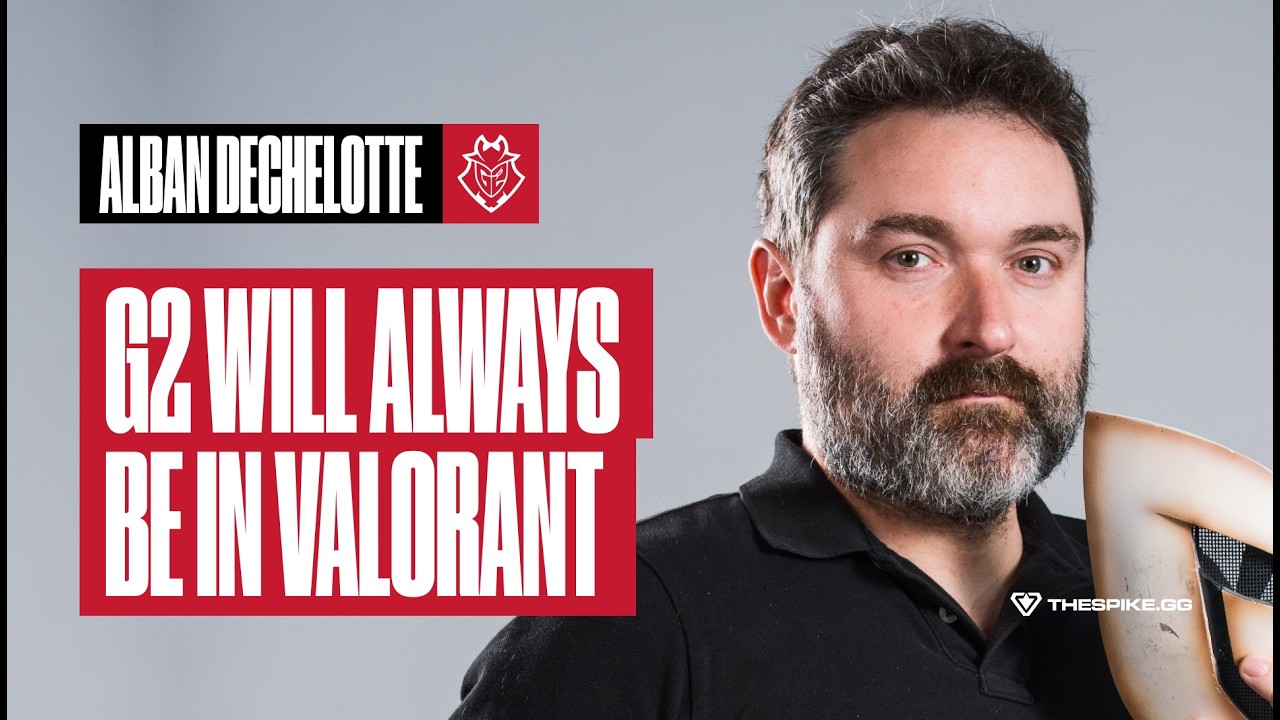
G2 CEO Alban Dechelotte: "There's not a world where G2 is not participating in VALORANT"
The VALORANT Champions Tour (VCT) is heading into its biggest shake-up since the partnership era was introduced in 2023. In October, Riot Games revealed its partner teams for the 2027–2028 cycle, cutting each international league from 12 partners to 8. Everyone else will now fight their way in through the Open Qualifiers, with results alone deciding who reaches Cups, Masters, and Champions.
G2 Esports made the cut in VCT Americas, alongside 100 Thieves, KRÜ Esports, Leviatán, LOUD, MIBR, NRG, and Sentinels. Several established organizations missed out, including Cloud9 and FURIA.
Few people understand that process from both sides of the table quite like Alban Dechelotte. Before becoming CEO of G2 Esports, Dechelotte served as Head of Partnerships and Business Development for EMEA at Riot Games.
In this exclusive interview, THESPIKE sat down with Dechelotte to discuss how G2 earned its spot in the VCT, why the application was really "the last four years," what G2 is buying into with a tighter, semi-open league, whether partner teams will poach T2 talent, and if the reported $600,000 to $5 million in annual payouts is enough to self-sustain its VALORANT division.
The Application is “The last four years”
Given his years at Riot, the obvious question was what the publisher actually looks for when it picks its partners. With prominent teams being rejected and eventually deciding to leave VALORANT altogether, the selection process seems to have been meticulous on behalf of Riot.
With just 8 teams selected for each of the regions; VCT China, VCT EMEA, VCT Americas, and VCT Pacific, the competition was expected to be fierce.
“The application is the last four years. You don't apply. You collaborate with Riot for the last four years, and they judge you on that, not just on the application."
Dechelotte's point is that a partner slot is earned long before anything is written down, and the application is simply where a team gets to make its case.
"The application is the opportunity for you to summarize what you did for the last four years," he explained. "So they judge you not just on what you say, but what you did, you know."
For G2, those four years started with an initial rejection, yet that was only the beginning of the road to redemption and success in VALORANT.
G2’s Road Back Into the VALORANT Champions Tour
When Riot announced its first group of VCT Americas partners in 2022, G2 wasn't on the list. Rather than walk away from the region, the organization doubled down.
"When we didn't get selected for VALORANT in North America four years ago, we decided to make a Challengers team in North America," Dechelotte said confidently. "So that was the first thing, to show Riot that, ‘okay, you didn't choose us this time, but we're going to fight, and we're going to keep committed to the choice of going to America and the choice to commit to VALORANT’."
The breakthrough came in 2023. The highly beloved team at the time, The Guard, had won Americas Ascension that July, and G2 signed the players in September, securing a two-year stay in VCT Americas as the league expanded to 11 teams.
"When we had an opportunity to make an offer to The Guard, we made a significant investment, in resources and financially, to convince the boys to choose G2," Dechelotte recalled. In his view, that move showed Riot just how serious G2 was about VALORANT.
The commitment didn't stop at the roster. G2 made a point of showing up at every single Masters over the last three years, "participating or not," with events, content, and fan activations. That work, Dechelotte says, also paid off in digital goods sales.
"We did engage the fans. We did create our fandom, both in North America, but also using the international events to build G2 internationally," he said.
By the time the 2027 application came around, G2's pitch more or less wrote itself.
"When we made our application, and we talked about the way we are ready to build the best roster possible, support them with the best staff, do all these things in content left and right, and who we are, I think it was just a summary of what we did for the last four years," Dechelotte said.
"And that's why I think we had a good application, because we didn't just talk about it. We just did it."
From Twelve to Eight Partnered Orgs
The biggest change for 2027 is the size of the league itself. Going from 12 partners to 8 per region is a decision Dechelotte calls "massive," and one that comes at a significant cost to some of the previously partnered organizations. Well-known teams such as Cloud9, Natus Vincere, or KIWOOM DRX have not made the cut, despite previously being a strong presence in VALORANT esports.
"That means that, you know, in the short term, we lose a lot of, like, strong brands," he said. "Like, I mean, Cloud9 is a model for me, and there's a lot of super cool teams that have been very popular and very active in VALORANT that are not part of the cut."
"And that's sad, but I'm immensely proud that G2 is part of the teams that have been selected…"
The long-term picture is brighter, though. With fewer guaranteed seats and a direct route in through the Open Qualifiers, Dechelotte expects a new wave of teams and talent to rise in the years ahead.
"There will be room, probably not next year, but the years after, for new players, new teams to come up, new talents. And the path for them to go into the big league and the big competition is much easier than in the past," he said. "They reduce in the short term the big teams, and they increase long-term the potential for new teams. And I think that's what they are trying to achieve here."
What G2 is Buying into for VCT 2027
Under the new VCT 2027 structure, partnership no longer comes with a guaranteed path to international events. Partners that underperform at Cups and Masters drop into the Open Playoffs and have to earn their spot back. So how does the CEO of G2 view this?
"First of all, I would say it (qualifying into big events) was never guaranteed. Like, if you look at a team like Sentinels, they didn't qualify much lately. And so I think it shows that even if you are a strong team, and you have a lot of popularity, and you invest a lot of money, probably too much, in player salaries, you're not guaranteed to qualify."
He pointed to LOUD and Leviatán, "with a lot of young players coming out of nowhere," as proof of how tough the league has become. LOUD backed that up in the biggest way possible, beating Team Vitality 3-1 in Shanghai to become the first organization to win Champions twice, and doing so with flair with the youngest roster at the event.
"I think this is a lesson learned. Like, we need to qualify, but we need to fight for it. And so the system will not change that," Dechelotte said. "Maybe we have to qualify now for the Cups, that's the difference. But for Champions, the Masters, it was never an easy fight."
What G2 is really buying into, he says, is "one of the fastest-growing leagues, fastest-growing sports." He contrasted VALORANT with Counter-Strike, which he sees as massively popular mainly in Europe, Russia, and Brazil, and League of Legends, whose audience leans heavily on Korea, China, and Europe.
"VALORANT is truly global. Like, in Japan, in China, in Korea, in Brazil, in the US, in Europe, it's super popular. So we are very happy, because this matches pretty well with the ambition we have for G2."
That ambition has already reshaped the organization. "G2 was born in Spain and Germany at the beginning, and then became very popular in Europe, and now our biggest market fandom is actually the US," Dechelotte said. "And we are also very popular in China."
Check out the interview with Alban over on Strafe to find out more on this topic.
Finding the Right Balance
Since 2023, the VCT has been built around a largely closed partnership system. From 2027, it will become a hybrid. Having worked on the publisher side, Dechelotte was quick to stress that it is often beneficial to be a core part of any esports ecosystem.
"I would first say that it's good to be in any ecosystem. We are very proud and happy and lucky to be selected," he said. "You can tell that the teams that are not selected at the moment are suffering more than the ones that have been selected."
Beyond that, he views the league design as a series of trade-offs rather than right or wrong answers.
"If you want high viewership, you should have playoffs and double elimination and the big teams playing each other a lot, you know, with high stakes. If you want to guarantee a lot of visibility for the teams, so that they can monetize with sponsors and create more engagement, then you need to have a long regular season with guaranteed games for everybody. That's not good for viewership."
"The longer the regular season is, the bigger the dip in the middle, you know, when the stakes are not so high," he added. "That's good for teams, because then teams can commit to sponsors to get visibility." The same tension applies to how open a league should be. "If you want to have a lot of new fans then you need to allow new teams to join. New players, new teams, new stories," Dechelotte said. "But if you want to have value creation for the teams, you have to close the ecosystem."
"So I don't think there's, like, a good or bad decision. It's more kind of like finding the balance between all these criteria."
From Alban’s observations, the closed era worked for the teams inside it, but it left Tier 2 struggling more than Riot expected. A hybrid model introduced by Riot tries to bridge the gap: "How do we maintain the value added to the teams while opening to Tier 2, so that Tier 2 has a chance to go all the way."
He pointed to his own roster's history as an example. The Guard's lineup won Ascension in July 2023, but had to wait until the following season to face partner teams in official matches.
"They didn't have an opportunity to have a look at whatever would happen if they would play against VCT teams outside of scrims, you know," Dechelotte said. "For me, it's a valuable attempt to find the best of both worlds."
Will Partner Teams Poach Talent?
One of the loudest criticisms of the semi-open system is what happens to the teams that come through it and “make it.” If a non-partner side qualifies for a big event, there's every chance a partner organization swoops in for its best players soon afterwards.
"I would expect that the teams are building protection against that. For example, a yearly contract that will have an exit clause for the player if he is called by the VCT partner teams, with, like, a payment of a buyout fee for the player, for the team."
Even without that protection, he firmly believes the new system is an upgrade on what came before. "I think this is a better system than Ascension, where most of the teams are not able to retain their players, and so they ascend, but without their players, and then it becomes very hard for them to compete," he said. "So I think it (the VCT 2027 circuit) is a better system."
There’s also a case to be made for a young talent with the potential to join one of the league's leaders. In such a scenario, a move up, in this case joining a partner team, could be the goal to achieve in the esport.
"Sometimes people compare G2 to Real Madrid. And I think when sometimes Real Madrid call a player from a team in Europe, in football, they want to join Real Madrid, you know?"
"I think this is also being part of an ecosystem where there will be more resources to support them in terms of staff and equipment and support for excellence," Dechelotte continued. "There will be also more fans and also more sponsors. So there's a lot of reasons why, as a player, if you have a chance, you want to join a bigger team."
Not every player will want to leave, of course. For a roster that's close-knit and determined to make it together, the open circuit now offers a route all the way to the top. "And I think the new system allows that," he claimed.
Is $600,000 to $5 million Enough?
Riot hasn't disclosed exact figures, but Americas partners will reportedly receive between $600,000 and $5 million a year from 2027, on top of their share of in-game digital goods. We asked Dechelotte whether that range is sufficient for the VALORANT team to be paying for itself.
"So first of all, I will always say it's not enough," he said, adding that he will always ask Riot for more. "But in reality, I think it's a positive move."
G2's expectation is that the overall pot grows, but that more of it goes to the rest of the ecosystem.
"We expect the global revenue pool to increase. We expect that the deductions, Game Changers, Open Qualifiers, Cups, prize money, will significantly reduce this prize pool, this revenue available, to basically the same level as last year."
"And because there's only eight teams instead of twelve, each team would have on average a bit more than last year," he explained. "That's kind of like the math that we have in mind. We probably need a year or two to understand exactly how the math adds up.”
Whatever the final figures, one thing won't change: international qualification is where the real value lies. "If you qualify for international events, you're in a better place," Dechelotte said. "Winning regionally is great, but it's not as impactful as qualifying for Masters and Champions. So we try to always qualify, and if we can win, even better."
Every roster has to pay for itself
So does VALORANT pay for itself at G2, or does the organization still have to subsidize it?
"For every roster, not just VALORANT, we try to build a system where the direct costs of having the roster are compensated by the direct revenue. Direct revenue could be what the publisher, the tournament organizers, or specific sponsors from the ecosystem are providing us."
Anything beyond that, from wider sponsorship deals to consumer products, goes into building the organization itself. "The marketing, the admin, the commercial, the new innovation, the new ventures are not paid by esports," he said. "They are paid by the revenue we generate outside of esports."
"And to be honest, it forces us to make some tough decisions," Dechelotte admitted. He pointed to two from outside VALORANT: G2 stepped away from Rocket League despite having a winning roster, and the organization let star player m0NESY leave its Counter-Strike team in 2025 because it wasn't in a position to renew him. "If the economics for each roster are not adding up, we are not continuing," he said.
The same thinking shapes how G2 pays its players. Salaries are only the starting point, with the bigger rewards tied to results.
"We build compensation for players so that there's a high incentive for them. Like, the salary is just the base for them participating, but the minute they start winning, in terms of prize money, in terms of digital goods, when they qualify for international events, they have stronger rewards," Dechelotte explained.
"There's not a world where G2 is not participating in VALORANT"
THESPIKE put a hypothetical before Alban. If G2 hadn't been selected as one of the partners for VCT 2027, would it have kept a roster and fought its way through the Open Qualifiers?
"Tough one to answer," he said. "I would just say that there's not a world where G2 is not participating in something in VALORANT, but I don't know how we'd have done it."
He mentioned G2's other VALORANT projects and an academy team the organization had considered in the past, but wouldn't be drawn any further.
"We would have been, for sure, in VALORANT, but I prefer not to speak on it."
Fortunately for G2 fans, that question stays merely hypothetical. G2 heads into 2027 as one of eight Americas partners. With the G2 roster yet to be unveiled, make sure to keep track of our VCT 2027 roster tracker as we keep updating it with the biggest and latest moves.
For the full interview, check out the YouTube video below.
For more exclusive interviews, news, and features, make sure to follow THESPIKE.GG.
Note: Some questions and answers have been slightly edited for clarity and or brevity. The order of questions and answers has also been changed for a more cohesive read.
A former ESL teacher with a Master’s degree in English Studies that found his drive in esports. Merging a passion for the craft of writing with a never-ending need to out-aim others in the game of VALORANT and Counter-Strike.
Naim began his esports-writing and reporting journey at DailyEsports (now Upcomer), where he was a contributor for CS:GO. More and more enamored with esports, he quickly received a chance to attend IEM Katowice 2019 as press and managed to interview Cath, Lekr0, FalleN, and jkaem, his first dive into covering an event on-site.
With the release of VALORANT, Naim saw potential in Riot Games’ take on a 5v5 competitive shooter and joined Run It Back as a writer. After 3 months, he got promoted to a Managing Editor, managing a team of contributors and held regular brainstorming meetings to get content pumping for 3 years straight. In that time he attended Masters Berlin 2021, as well as VALORANT Champions 2022 as press on-site press.
Now, Naim is a Content Manager & Editor at THESPIKE. He keeps tabs on news, features, and evergreen content production, as well as contributing himself from time to time.


Comments
0