How to wave dash in Rocket League: Everything you need to know

If you are using simple controls in the game, you are missing a lot, and probably falling behind your competitors. There are many different mechanics in Rocket League that will help you get better at the game, like wave dashing. This guide explains what a wavedash does, how to execute it with clean timing, where it fits in real matches and more!
What is wave dashing in Rocket League?
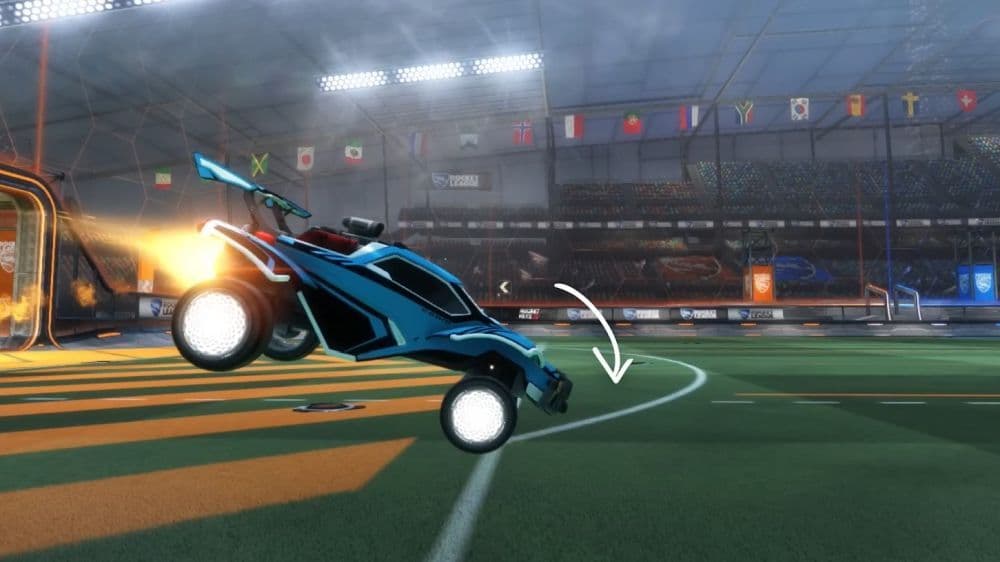
A wavedash is a dodge that you trigger right as your wheels touch the ground. The ground cancels most of the flip motion, and you still get the burst of speed from the dodge. You gain momentum without the long commitment of a full front flip.
That speed matters because Rocket League rewards early arrival. It rewards quick recoveries. It rewards small wins in space. A clean wavedash helps you do all three while you keep control.
Use wavedashes for three main reasons:
- Recover faster after a touch: You land and rejoin rotation sooner.
- Save boost: You keep pace without burning pads you may need later.
- Stay flexible: You keep your nose available for a challenge instead of locking into a full flip.
How to wavedash in Rocket League
You do not need advanced aerial control to learn a wavedash. You need timing and a small tilt. Start in Free Play, and keep the car low and stable.
The basic forward wavedash
Use this sequence and repeat it until it feels boring.
- Jump once: Keep the jump short.
- Tilt the car slightly: Aim the nose a little forward. Do not slam it down.
- Let the wheels touch the ground: Watch for the first contact.
- Dodge at contact: Press jump again and hold forward.
- Stabilize: Use a light powerslide if the car drifts off line.
If you do it right, you feel a quick burst and you keep steering control. If you do it wrong, you see a full flip or no speed gain.
Don’t forget to check out our guide on how to speed flip in Rocket League for better mechanics and controls in the game!
Side and diagonal wavedashes for sharper lines
Forward wavedashes help you move upfield. Side and diagonal wavedashes help you rotate and angle your car without losing pace.
- Side wavedash: dodge left or right at wheel contact.
- Diagonal wavedash: hold a diagonal direction at wheel contact.
These versions help when you need speed and a turn at the same time. They also help when the play forces you into curved paths around teammates and opponents.
Common errors and fast fixes
Most players fail wavedashes for predictable reasons. Fix them with small changes.
- You full flip and lose control: Reduce the tilt. Dodge earlier at wheel contact.
- You get no burst: Dodge closer to the first wheel touch. Do not wait until the car fully settles.
- You bounce and feel slow: Keep the first jump short. A high hop adds hang time and breaks timing.
- You land crooked and spin out: Add a quick powerslide and keep your tilt gentle.
- You miss the dodge input: Adjust dodge deadzone, and press the second jump with more intent.
Tips and tricks to perform better wave dashes
Mechanics improve faster when your inputs feel predictable. Two settings matter most for wavedashes: dodge deadzone and binds that support quick recovery.
Dodge deadzone
Dodge deadzone controls how far you must push the stick before Rocket League registers a dodge direction. A very high value can make dodges feel late or inconsistent. A very low value can trigger accidental dodges.
A practical approach works best:
- If you miss dodges or get no direction, lower the value slightly.
- If you misfire dodges, raise the value slightly.
- Change it in small steps, then test for two minutes.
Bind priorities
You want quick access to three actions during recoveries.
- Jump must feel instant.
- Powerslide must sit on a button you press without thought.
- Air roll must feel stable if you use it for landings.
You do not need a “perfect” pro setup. You need a setup that lets you jump, land, and correct your car without finger confusion.
Advantages of wave dashing
Wavedashing feels like a training trick until you attach it to match moments. Use it as a recovery tool first. Use it as a speed tool second.
High-value situations
- After an aerial touch: You land, wavedash, and rotate back into the play.
- After a 50/50: You regain speed faster than the other car.
- After a wall drop: You hit the curve, wavedash, and keep momentum.
- During low-boost rotations: You stay fast while you collect small pads.
- During shadow defense: You keep speed while you stay ready to challenge.
Advanced wavedash variations to learn next
Once the basic wavedash feels stable, you can layer in variations that fit higher-speed games. Learn one at a time. Do not rush.
Chain dashes for sustained speed
Chain dashes link multiple wavedashes across small hops. Players use them to keep speed in long rotations, often when boost runs thin. This skill demands rhythm and clean landings, so it rewards patience.
Walldashes and curve control
You can also build speed with dodge timing on wall exits and curved surfaces. These variations help most when you play fast backboard reads or when you rotate off the side wall and need to re-enter the field at speed.
How to practice wave dashing
You do not need a long routine. You need repetition with a simple goal and a good workshop map.
10-minute plan:
- 2 minutes: forward wavedash in a straight line, then stop and repeat.
- 3 minutes: forward wavedash into a gentle turn, then recover with powerslide.
- 3 minutes: side wavedash left and right, then drive a figure-eight path.
- 2 minutes: jump off the wall, land, and wavedash back toward center.
Wavedashing gives you speed with control. It also saves boost and shortens your recovery time. Learn the forward version first, then add side and diagonal versions, and then apply it in real rotations.
Featured Image Credit: Rocket League
Guide Categories
All Related Guides
 Rocket League Easy Anti-Cheat (EAC) explainedRocket League Easy Anti-Cheat explained: how EAC works, online requirements, mod support, Linux compatibility,...
 How to play custom maps in Rocket LeagueDiscover how to play custom maps in Rocket League with a quick guide to setup, loaders, and the best maps for ...
 How to horse dash in Rocket LeagueLearn how to horse dash in Rocket League with simple steps, key tips, and common mistakes to avoid in this qui...
 How to air roll in Rocket LeagueHow to air roll in Rocket League: controls, settings, tips, and step-by-step guide to improve aerial control....
 How to fast aerial in Rocket League like a proMaster how to fast aerial in Rocket League with a clear guide on timing, boost control, aerial practice, and c...
 How to get your Rocket Rundown 2026How to get your Rocket Rundown 2026: access your Rocket League stats recap, view playstyle insights, and impro...
 Rocket League “Complete a Custom Training Using Randomization” challenge explainedLearn how to complete the Rocket League Complete a Custom Training Using Randomization challenge with this qui...
 9 ways to get goal explosions in Rocket League Learn how to get goal explosions in Rocket League with 9 methods including Rocket Pass, Drops, tournaments, bl...
- 1
- 2
- 3
- 4
- 5
- 6
- 7